

Axions
163
' Y
.... a
....
....
....
'" '"
....
~n
(Z,A)
(Z,A)
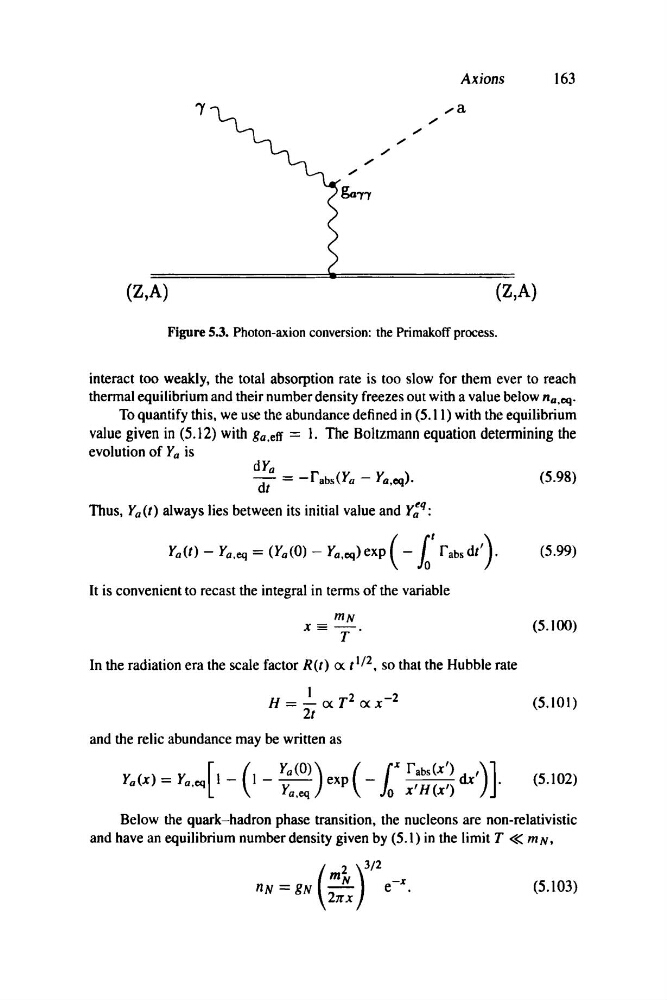
Figure 5.3. Photon-axion conversion: the Primakoff process.
interact too weakly. the total absorption rate is too slow for them ever to reach
thermal equilibrium and their number density freezes out with a value below na.cq.
To quantify this. we use the abundance defined in (5.11) with the equilibrium
value given in (5.12) with ga.eff = 1. The Boltzmann equation determining the
evolution of Y a is
dYa
dt = -rabs(Ya Y.,cq)'
(5.98)
Thus, Ya(t) always lies between its initial value and y: q :
Ya(t) - Ya.cq = (Ya(O) - Ya,cq)exp ( fot rabsdt').
(5.99)
It is convenient to recast the integral in terms of the variable
mN
x=T'
(5.100)
In the radiation era the scale factor R(t) ex t l / 2 , so that the Hubble rate
1
H = - ex T2 exx- 2
(5.101)
2t
and the relic abundance may be written as
Ya(O»)
(
rabs(X') ,)]
(5.102)
Ya(x)
[
(
= Ya,cq 1 - I - Ya.cq exp - Jo re x' H (x') dx .
Below the quark-hadron phase transition. the nucleons are non-relativistic
and have an equilibrium number density given by (5.1) in the limit T « m N.
nN =gN
2 )3/2
( mN e- x
(5.103)
21l'X
•
163
' Y
.... a
....
....
....
'" '"
....
~n
(Z,A)
(Z,A)
Figure 5.3. Photon-axion conversion: the Primakoff process.
interact too weakly. the total absorption rate is too slow for them ever to reach
thermal equilibrium and their number density freezes out with a value below na.cq.
To quantify this. we use the abundance defined in (5.11) with the equilibrium
value given in (5.12) with ga.eff = 1. The Boltzmann equation determining the
evolution of Y a is
dYa
dt = -rabs(Ya Y.,cq)'
(5.98)
Thus, Ya(t) always lies between its initial value and y: q :
Ya(t) - Ya.cq = (Ya(O) - Ya,cq)exp ( fot rabsdt').
(5.99)
It is convenient to recast the integral in terms of the variable
mN
x=T'
(5.100)
In the radiation era the scale factor R(t) ex t l / 2 , so that the Hubble rate
1
H = - ex T2 exx- 2
(5.101)
2t
and the relic abundance may be written as
Ya(O»)
(
rabs(X') ,)]
(5.102)
Ya(x)
[
(
= Ya,cq 1 - I - Ya.cq exp - Jo re x' H (x') dx .
Below the quark-hadron phase transition. the nucleons are non-relativistic
and have an equilibrium number density given by (5.1) in the limit T « m N.
nN =gN
2 )3/2
( mN e- x
(5.103)
21l'X
•