

Axions
155
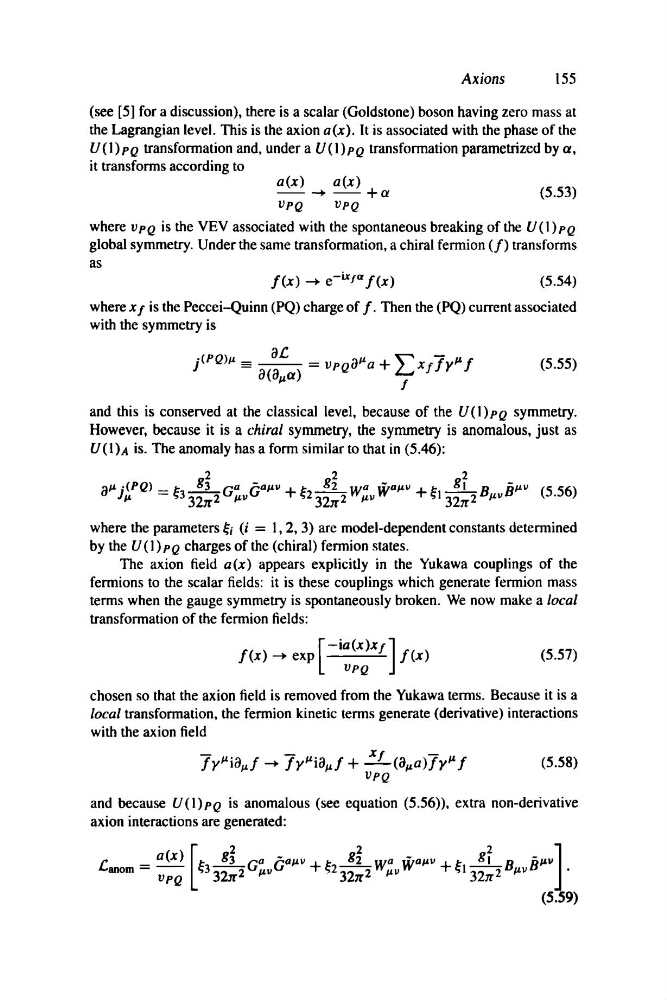
(see [S] for a discussion), there is a scalar (Goldstone) boson baving zero mass at
the Lagrangian level. This is the axion a (x). It is associated with the phase of the
U(l)PQ transformation and, under a U(l)PQ transformation parametrized by u,
it transforms according to
a(x)
a(x)
- - + - + u
(S.53)
vPQ
vPQ
where v PQ is the VEV associated with the spontaneous breaking of the U (1) PQ
global symmetry. Under the same transformation, a chiral fermion (f) transforms
as
I(x) ~ e- iz/a I(x)
(5.54)
where x I is the Peccei-Quinn (PQ) charge of I. Then the (PQ) current associated
with the symmetry is
j(PQ)1' = ~ = vPQal'a + LXf/YP-I
(5.5S)
a (al'u)
I
and this is conserved at the classical level, because of the U(l)PQ symmetry.
However, because it is a chiral symmetry, the symmetry is anomalous, just as
U(l)A is. The anomaly has a form similar to that in (5.46):
2
2
2
aP-J·(PQ) = 1:3~GQ OQI'I) + 1:2~ W Q WDI'I) + I: ~B jjl'l) (5 S6)
P'i 32n'2 1'1)
'i 32n'2 1'1)
'i 1 321f2 1'1)
.
where the parameters ~i (i = I, 2, 3) are model-dependent constants determined
by the U(l)PQ charges of the (chiral) fermion states.
The axion field a(x) appears explicitly in the Yukawa couplings of the
fermions to the scalar fields: it is these couplings which generate fermion mass
terms when the gauge symmetry is spontaneously broken. We now make a local
transformation of the fermion fields:
-ia(X)Xf ]
I(x) -+ exp [
I(x)
(S.57)
vPQ
chosen so that the axion field is removed from the Yukawa terms. Because it is a
local transformation, the fermi on kinetic terms generate (derivative) interactions
with the axion field
/yl'ial'l -+ /yP-ial'l + XI (al'a)/yl'l
(S.S8)
vPQ
and because U(l)PQ is anomalous (see equation (S.56», extra non-derivative
axion interactions are generated:
(,
= a(x) [1:3 g~ G D ODI'I) + "2 g~ W D WDI'I) + I: -.!LB 81'11]
anom
VPQ 'i 32n'2 IlII
., 32n'2 Ill)
.,1 321f2 IlII
•
(S.S9)
155
(see [S] for a discussion), there is a scalar (Goldstone) boson baving zero mass at
the Lagrangian level. This is the axion a (x). It is associated with the phase of the
U(l)PQ transformation and, under a U(l)PQ transformation parametrized by u,
it transforms according to
a(x)
a(x)
- - + - + u
(S.53)
vPQ
vPQ
where v PQ is the VEV associated with the spontaneous breaking of the U (1) PQ
global symmetry. Under the same transformation, a chiral fermion (f) transforms
as
I(x) ~ e- iz/a I(x)
(5.54)
where x I is the Peccei-Quinn (PQ) charge of I. Then the (PQ) current associated
with the symmetry is
j(PQ)1' = ~ = vPQal'a + LXf/YP-I
(5.5S)
a (al'u)
I
and this is conserved at the classical level, because of the U(l)PQ symmetry.
However, because it is a chiral symmetry, the symmetry is anomalous, just as
U(l)A is. The anomaly has a form similar to that in (5.46):
2
2
2
aP-J·(PQ) = 1:3~GQ OQI'I) + 1:2~ W Q WDI'I) + I: ~B jjl'l) (5 S6)
P'i 32n'2 1'1)
'i 32n'2 1'1)
'i 1 321f2 1'1)
.
where the parameters ~i (i = I, 2, 3) are model-dependent constants determined
by the U(l)PQ charges of the (chiral) fermion states.
The axion field a(x) appears explicitly in the Yukawa couplings of the
fermions to the scalar fields: it is these couplings which generate fermion mass
terms when the gauge symmetry is spontaneously broken. We now make a local
transformation of the fermion fields:
-ia(X)Xf ]
I(x) -+ exp [
I(x)
(S.57)
vPQ
chosen so that the axion field is removed from the Yukawa terms. Because it is a
local transformation, the fermi on kinetic terms generate (derivative) interactions
with the axion field
/yl'ial'l -+ /yP-ial'l + XI (al'a)/yl'l
(S.S8)
vPQ
and because U(l)PQ is anomalous (see equation (S.56», extra non-derivative
axion interactions are generated:
(,
= a(x) [1:3 g~ G D ODI'I) + "2 g~ W D WDI'I) + I: -.!LB 81'11]
anom
VPQ 'i 32n'2 IlII
., 32n'2 Ill)
.,1 321f2 IlII
•
(S.S9)