

154
Relic neutrinos and axions
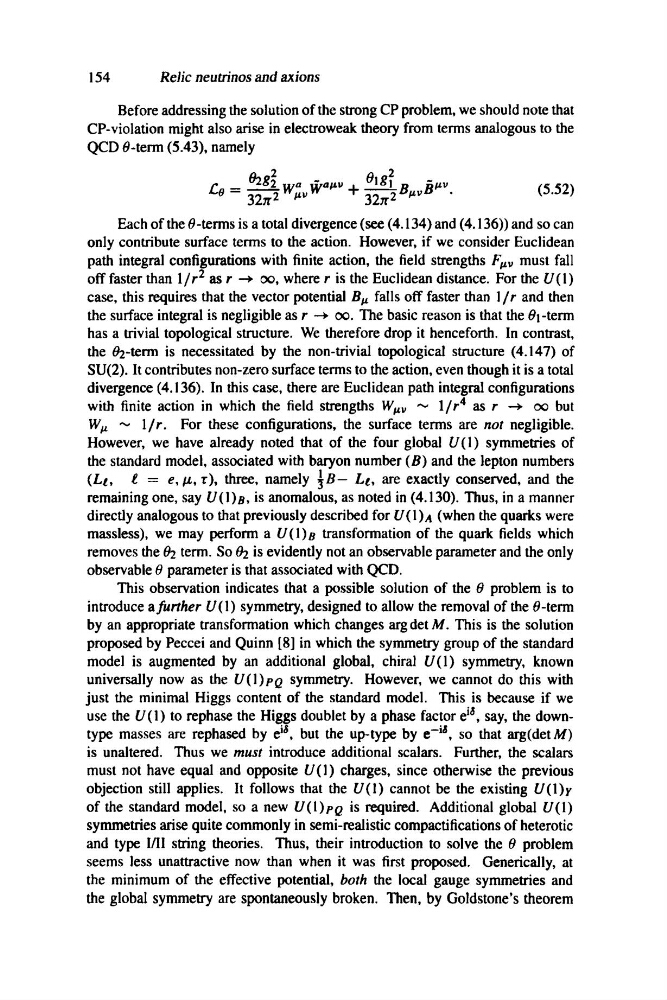
Before addressing the solution of the strong CP problem, we should note that
CP-violation might also arise in electroweak theory from terms analogous to the
QCD 8-term (5.43), namely
a. 2
8 2
4 = ~ WO WO"" + --.!!!. Ba""
(5.52)
3211'2 ""
3211'2 11-"
•
Each of the 8-terms is a total divergence (see (4. 134) and (4.136» and so can
only contribute surface terms to the action. However, if we consider Euclidean
path integral configurations with finite action, the field strengths F"" must fall
off faster than 1/ r2 as r -+ 00, where r is the Euclidean distance. For the V (I)
case, this requires that the vector potential B" falls off faster than l/r and then
the surface integral is negligible as r -+ 00. The basic reason is that the 81-term
has a trivial topological structure. We therefore drop it henceforth. In contrast,
the (h-term is necessitated by the non-trivial topological structure (4.147) of
SU(2). It contributes non-zero surface terms to the action, even though it is a total
divergence (4.136). In this case, there are Euclidean path integral configurations
with finite action in which the field strengths W"" . -. . ; l/r4 as r -+ 00 but
W" ...... 1/ r . For these configurations, the surface terms are not negligible.
However, we have already noted that of the four global V ( I) symmetries of
the standard model, associated with baryon number (B) and the lepton numbers
(Lt., l = e, /.L, 1'), three, namely lB- Lt., are exactly conserved, and the
remaining one, say V (l) 8, is anomalous, as noted in (4.130). Thus, in a manner
directly analogous to that previously described for V(I)A (when the quarks were
massless), we may perform a V(I)8 transformation of the quark fields which
removes the (h term. So (h is evidently not an observable parameter and the only
observable (J parameter is that associated with QCD.
This observation indicates that a possible solution of the 8 problem is to
introduce afurther V(l) symmetry, designed to allow the removal of the 8-term
by an appropriate transformation which changes arg det M. This is the solution
proposed by Peccei and Quinn [8] in which the symmetry group of the standard
model is augmented by an additional global, chiral V (l) symmetry, known
universally now as the V (1) PQ symmetry. However, we cannot do this with
just the minimal Higgs content of the standard model. This is because if we
use the U(l) to rephase the Higgs doublet by a phase factor e i &, say, the downtype masses are rephased by e i &, but the up-type by e- iJ , so that arg(detM)
is unaltered. Thus we must introduce additional scalars. Further, the scalars
must not have equal and opposite V(l) charges, since otherwise the previous
objection still applies. It follows that the V(1) cannot be the existing V(I)y
of the standard model, so a new V(I)PQ is required. Additional global V(I)
symmetries arise quite commonly in semi-realistic compactifications of heterotic
and type 1111 string theories. Thus, their introduction to solve the 8 problem
seems less unattractive now than when it was first proposed. Generically, at
the minimum of the effective potential, both the local gauge symmetries and
the global symmetry are spontaneously broken. Then, by Goldstone's theorem
Relic neutrinos and axions
Before addressing the solution of the strong CP problem, we should note that
CP-violation might also arise in electroweak theory from terms analogous to the
QCD 8-term (5.43), namely
a. 2
8 2
4 = ~ WO WO"" + --.!!!. Ba""
(5.52)
3211'2 ""
3211'2 11-"
•
Each of the 8-terms is a total divergence (see (4. 134) and (4.136» and so can
only contribute surface terms to the action. However, if we consider Euclidean
path integral configurations with finite action, the field strengths F"" must fall
off faster than 1/ r2 as r -+ 00, where r is the Euclidean distance. For the V (I)
case, this requires that the vector potential B" falls off faster than l/r and then
the surface integral is negligible as r -+ 00. The basic reason is that the 81-term
has a trivial topological structure. We therefore drop it henceforth. In contrast,
the (h-term is necessitated by the non-trivial topological structure (4.147) of
SU(2). It contributes non-zero surface terms to the action, even though it is a total
divergence (4.136). In this case, there are Euclidean path integral configurations
with finite action in which the field strengths W"" . -. . ; l/r4 as r -+ 00 but
W" ...... 1/ r . For these configurations, the surface terms are not negligible.
However, we have already noted that of the four global V ( I) symmetries of
the standard model, associated with baryon number (B) and the lepton numbers
(Lt., l = e, /.L, 1'), three, namely lB- Lt., are exactly conserved, and the
remaining one, say V (l) 8, is anomalous, as noted in (4.130). Thus, in a manner
directly analogous to that previously described for V(I)A (when the quarks were
massless), we may perform a V(I)8 transformation of the quark fields which
removes the (h term. So (h is evidently not an observable parameter and the only
observable (J parameter is that associated with QCD.
This observation indicates that a possible solution of the 8 problem is to
introduce afurther V(l) symmetry, designed to allow the removal of the 8-term
by an appropriate transformation which changes arg det M. This is the solution
proposed by Peccei and Quinn [8] in which the symmetry group of the standard
model is augmented by an additional global, chiral V (l) symmetry, known
universally now as the V (1) PQ symmetry. However, we cannot do this with
just the minimal Higgs content of the standard model. This is because if we
use the U(l) to rephase the Higgs doublet by a phase factor e i &, say, the downtype masses are rephased by e i &, but the up-type by e- iJ , so that arg(detM)
is unaltered. Thus we must introduce additional scalars. Further, the scalars
must not have equal and opposite V(l) charges, since otherwise the previous
objection still applies. It follows that the V(1) cannot be the existing V(I)y
of the standard model, so a new V(I)PQ is required. Additional global V(I)
symmetries arise quite commonly in semi-realistic compactifications of heterotic
and type 1111 string theories. Thus, their introduction to solve the 8 problem
seems less unattractive now than when it was first proposed. Generically, at
the minimum of the effective potential, both the local gauge symmetries and
the global symmetry are spontaneously broken. Then, by Goldstone's theorem