

Axions
151
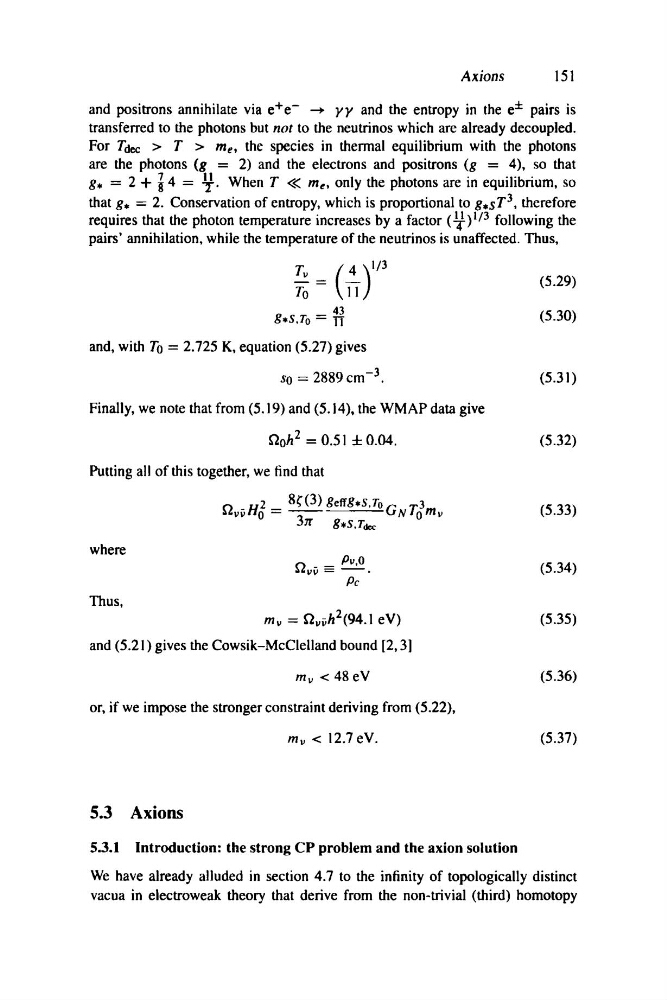
and positrons annihilate via e+e- -+ yy and the entropy in the e± pairs is
transferred to the photons but not to the neutrinos which are already decoupJed.
For Tdec > T > me, the species in thennal equilibrium with the photons
are the photons (g = 2) and the electrons and positrons (g = 4), so that
g. = 2 + i 4 = 1/. When T « me, only the photons are in eqUilibrium, so
that g. = 2. Conservation of entropy, which is proportional to g.sT 3 , therefore
requires that the photon temperature increases by a factor (lJ-)1/3 following the
pairs' annihilation, while the temperature of the neutrinos is unaffected. Thus,
T" = (~)1/3
(5.29)
To
11
g .s. 7i - 43
0 - TT
(5.30)
and, with To = 2.725 K, equation (5.27) gives
so = 2889cm- 3 •
(5.31)
Finally, we note that from (5.19) and (5.14), the WMAP data give
noh2 = 0.51 ± 0.04.
(5.32)
Putting all of this together, we find that
n -H2 _ 8~(3) gelfg.S,To G T,3
~""" 0 -3(5.33)
Nom"
1r
g.S.Tdcc
where
n"v == P",o
(5.34)
Pc
Thus,
m" = n"vh2(94.1 eV)
(5.35)
and (5.21) gives the Cowsik-McClelland bound [2,3]
m" < 48eV
(5.36)
or, if we impose the stronger constraint deriving from (5.22),
m" < 12.7eV.
(5.37)
5.3 Axions
5.3.1 Introduction: the strong CP problem and the axion solution
We have already alluded in section 4.7 to the infinity of topologically distinct
vacua in electroweak theory that derive from the non-trivial (third) homotopy
151
and positrons annihilate via e+e- -+ yy and the entropy in the e± pairs is
transferred to the photons but not to the neutrinos which are already decoupJed.
For Tdec > T > me, the species in thennal equilibrium with the photons
are the photons (g = 2) and the electrons and positrons (g = 4), so that
g. = 2 + i 4 = 1/. When T « me, only the photons are in eqUilibrium, so
that g. = 2. Conservation of entropy, which is proportional to g.sT 3 , therefore
requires that the photon temperature increases by a factor (lJ-)1/3 following the
pairs' annihilation, while the temperature of the neutrinos is unaffected. Thus,
T" = (~)1/3
(5.29)
To
11
g .s. 7i - 43
0 - TT
(5.30)
and, with To = 2.725 K, equation (5.27) gives
so = 2889cm- 3 •
(5.31)
Finally, we note that from (5.19) and (5.14), the WMAP data give
noh2 = 0.51 ± 0.04.
(5.32)
Putting all of this together, we find that
n -H2 _ 8~(3) gelfg.S,To G T,3
~""" 0 -3(5.33)
Nom"
1r
g.S.Tdcc
where
n"v == P",o
(5.34)
Pc
Thus,
m" = n"vh2(94.1 eV)
(5.35)
and (5.21) gives the Cowsik-McClelland bound [2,3]
m" < 48eV
(5.36)
or, if we impose the stronger constraint deriving from (5.22),
m" < 12.7eV.
(5.37)
5.3 Axions
5.3.1 Introduction: the strong CP problem and the axion solution
We have already alluded in section 4.7 to the infinity of topologically distinct
vacua in electroweak theory that derive from the non-trivial (third) homotopy