

150
Relic neutrinos and axions
5.2 Relic neutrinos
Uniquely among elementary particles, neutrinos participate only in weak: (and
gravitational) interactions. In the early universe, scattering processes, such as
ve ++- ve, and annihilation processes, such as vii ++- ee, kept the neutrinos in
thermal equilibrium. The total cross section for such processes is a '" G} T2,
just on dimensional grounds, since the weak: (Fermi) coupling constant G F ......
IQ- S m;V2 has dimensions [M- 2 ]. Since from (5.3) the relativistic number density
nll,eq is proportional to T3, the total interaction rate fint ...... avnll.eq ...... G}TS.
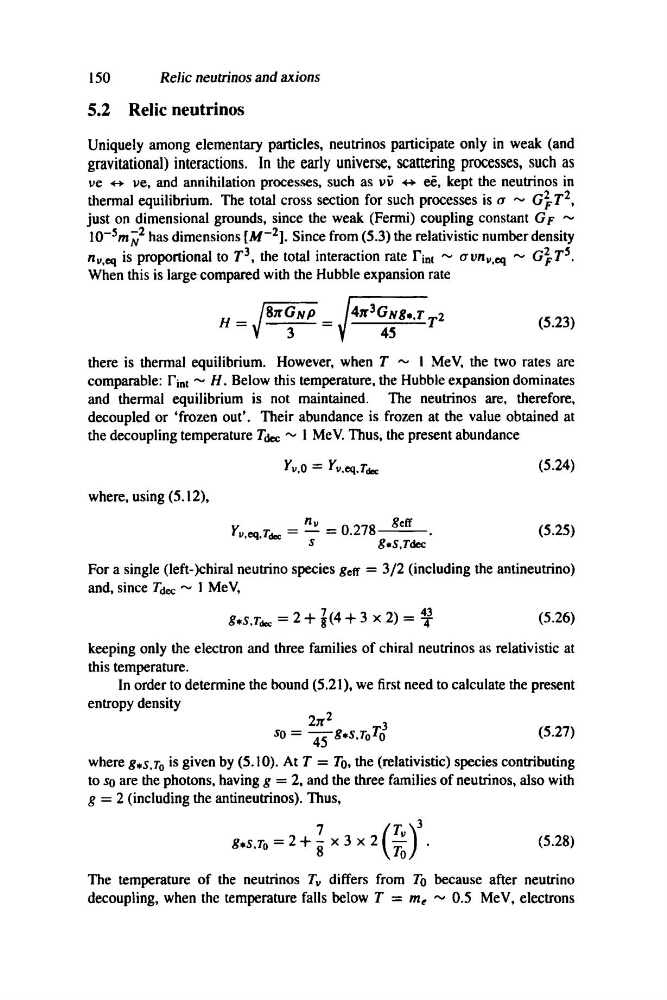
When this is large compared with the Hubble expansion rate
47r 3 GNg •• T T2
H = J87rGNP
(5.23)
3
45
there is thermal equilibrium. However, when T ...... I MeV, the two rates are
comparable: fint ...... H. Below this temperature, the Hubble expansion dominates
and thermal equilibrium is not maintained. The neutrinos are, therefore,
decoupled or 'frozen out'. Their abundance is frozen at the value obtained at
the decoupling temperature T dec ...... I Me V. Thus, the present abundance
YII,o = YII,eq,Tdec
(5.24)
where, using (5.12).
nv
gelT
Yv,eq,Tdec = - = 0.278--(5.25)
s
g.S,Tdec
For a single (Ieft-)chiral neutrino species 8eiT = 3/2 (including the antineutrino)
and. since Tdec ...... I MeV,
g.S.Tdec = 2 + ~(4 + 3 x 2) = ¥
(5.26)
keeping only the electron and three families of chiral neutrinos as relativistic at
this temperature.
In order to determine the bound (5.21). we first need to calculate the present
entropy density
27r 2
3
so = 45 g.s.ToTo
(5.27)
where g.s. To is given by (5.10). At T = To, the (relativistic) species contributing
to So are the photons. having g = 2. and the three families of neutrinos, also with
g = 2 (including the antineutrinos). Thus.
7
(T. )3
g.S,To = 2 + 8 x 3 x 2 :a
(5.28)
The temperature of the neutrinos Tv differs from To because after neutrino
decoupling, when the temperature falls below T = me '" 0.5 MeV. electrons
Relic neutrinos and axions
5.2 Relic neutrinos
Uniquely among elementary particles, neutrinos participate only in weak: (and
gravitational) interactions. In the early universe, scattering processes, such as
ve ++- ve, and annihilation processes, such as vii ++- ee, kept the neutrinos in
thermal equilibrium. The total cross section for such processes is a '" G} T2,
just on dimensional grounds, since the weak: (Fermi) coupling constant G F ......
IQ- S m;V2 has dimensions [M- 2 ]. Since from (5.3) the relativistic number density
nll,eq is proportional to T3, the total interaction rate fint ...... avnll.eq ...... G}TS.
When this is large compared with the Hubble expansion rate
47r 3 GNg •• T T2
H = J87rGNP
(5.23)
3
45
there is thermal equilibrium. However, when T ...... I MeV, the two rates are
comparable: fint ...... H. Below this temperature, the Hubble expansion dominates
and thermal equilibrium is not maintained. The neutrinos are, therefore,
decoupled or 'frozen out'. Their abundance is frozen at the value obtained at
the decoupling temperature T dec ...... I Me V. Thus, the present abundance
YII,o = YII,eq,Tdec
(5.24)
where, using (5.12).
nv
gelT
Yv,eq,Tdec = - = 0.278--(5.25)
s
g.S,Tdec
For a single (Ieft-)chiral neutrino species 8eiT = 3/2 (including the antineutrino)
and. since Tdec ...... I MeV,
g.S.Tdec = 2 + ~(4 + 3 x 2) = ¥
(5.26)
keeping only the electron and three families of chiral neutrinos as relativistic at
this temperature.
In order to determine the bound (5.21). we first need to calculate the present
entropy density
27r 2
3
so = 45 g.s.ToTo
(5.27)
where g.s. To is given by (5.10). At T = To, the (relativistic) species contributing
to So are the photons. having g = 2. and the three families of neutrinos, also with
g = 2 (including the antineutrinos). Thus.
7
(T. )3
g.S,To = 2 + 8 x 3 x 2 :a
(5.28)
The temperature of the neutrinos Tv differs from To because after neutrino
decoupling, when the temperature falls below T = me '" 0.5 MeV. electrons