

152
Relic neutrinos and axions
class of the electroweak SU(2) gauge group, as noted in (4.147). Since SU(2)
is a subgroup of SU(3), similar conclusions apply to QCD and
1r3(SU(3» = Z.
(5.38)
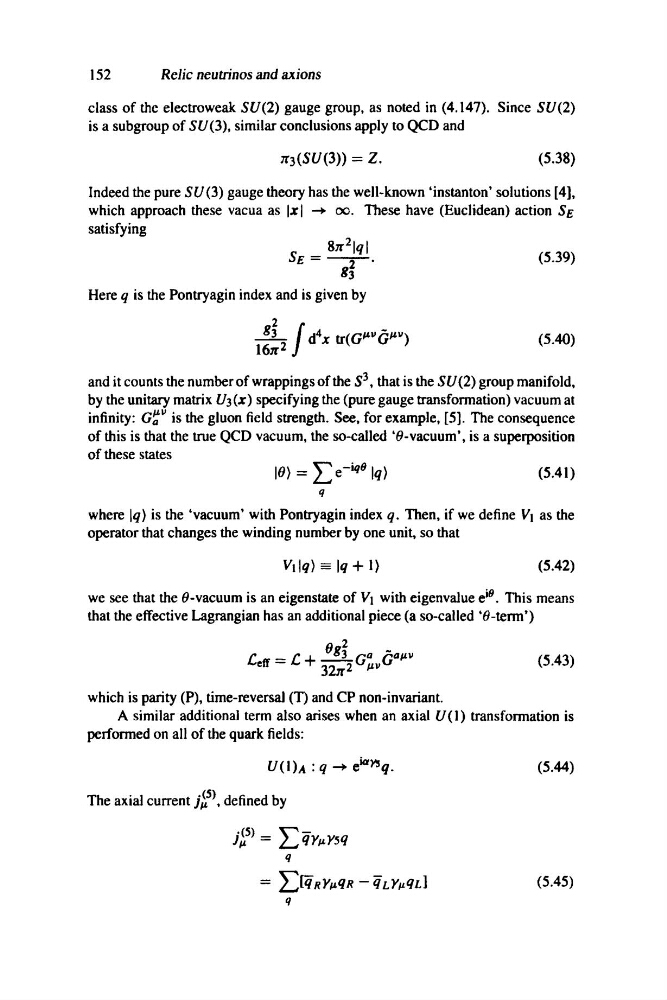
Indeed the pure SU(3) gauge theory has the well-known 'instanton' solutions [4],
which approach these vacua as Ixl -+ 00. These have (Euclidean) action SE
satisfying
SE = 81r2~q I.
(5.39)
13
Here q is the Pontryagin index and is given by
d fd 4 X tr(GI./. ... OI./.")
(5.40)
161r 2
and it counts the number of wrappings of the S3, that is the SU(2) group manifold,
by the unitary matrix U3 (x) specifying the (pure gauge transformation) vacuum at
infinity: G:" is the gluon field strength. See, for example, [5J. The consequence
of this is that the true QCD vacuum, the so-called '9-vacuum', is a superposition
of these states
19) = Le- iq8 Iq)
(5.41)
q
where Iq) is the 'vacuum' with Pontryagin index q. Then, if we define VI as the
operator that changes the winding number by one unit, so that
VJlq) == Iq + I)
(5.42)
we see that the 9-vacuum is an eigenstate of VI with eigenvalue e i8 • This means
that the effective Lagrangian has an additional piece (a so-called 'O-term')
9 2
C ff = C + ....!!.G Q OQI./."
(5.43)
e
321r2 1./."
which is parity (P), time-reversal (T) and CP non-invariant.
A similar additional term also arises when an axial U (I) transformation is
performed on all of the quark fields:
U(l)A : q -+ eiaY5 q.
(5.44)
The axial current j~5), defined by
if') = LqYI./.Y,q
q
= LliRYl./.qR -tlLYl./.qd
(5.45)
q
Relic neutrinos and axions
class of the electroweak SU(2) gauge group, as noted in (4.147). Since SU(2)
is a subgroup of SU(3), similar conclusions apply to QCD and
1r3(SU(3» = Z.
(5.38)
Indeed the pure SU(3) gauge theory has the well-known 'instanton' solutions [4],
which approach these vacua as Ixl -+ 00. These have (Euclidean) action SE
satisfying
SE = 81r2~q I.
(5.39)
13
Here q is the Pontryagin index and is given by
d fd 4 X tr(GI./. ... OI./.")
(5.40)
161r 2
and it counts the number of wrappings of the S3, that is the SU(2) group manifold,
by the unitary matrix U3 (x) specifying the (pure gauge transformation) vacuum at
infinity: G:" is the gluon field strength. See, for example, [5J. The consequence
of this is that the true QCD vacuum, the so-called '9-vacuum', is a superposition
of these states
19) = Le- iq8 Iq)
(5.41)
q
where Iq) is the 'vacuum' with Pontryagin index q. Then, if we define VI as the
operator that changes the winding number by one unit, so that
VJlq) == Iq + I)
(5.42)
we see that the 9-vacuum is an eigenstate of VI with eigenvalue e i8 • This means
that the effective Lagrangian has an additional piece (a so-called 'O-term')
9 2
C ff = C + ....!!.G Q OQI./."
(5.43)
e
321r2 1./."
which is parity (P), time-reversal (T) and CP non-invariant.
A similar additional term also arises when an axial U (I) transformation is
performed on all of the quark fields:
U(l)A : q -+ eiaY5 q.
(5.44)
The axial current j~5), defined by
if') = LqYI./.Y,q
q
= LliRYl./.qR -tlLYl./.qd
(5.45)
q