

464
O. Dimensional Regularization
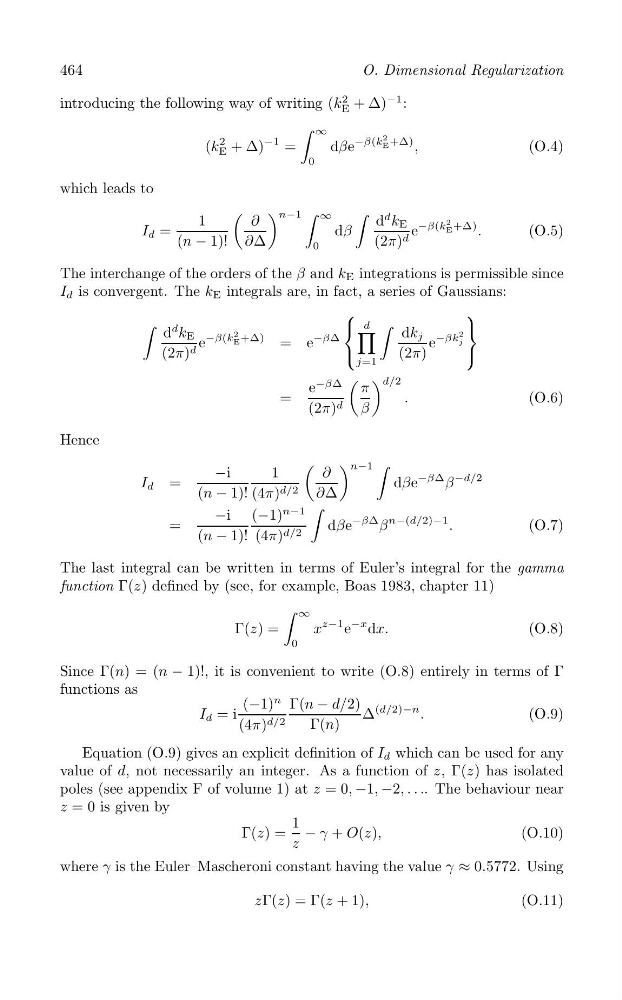
introducing the following way of writing (k
2 + Δ)
−1
E
:
∫
(k
2 + Δ)
−1
∞
=
dβe
−β(k
2
E +Δ)
E
,
(O.4)
0
which leads to
(
) n 1 ∫
∫
1
∂
−
∞
d
d k E
I =
dβ
e
−β(k
2
E +Δ)
d
.
(O.5)
(n − 1)! ∂Δ
(2π) d
0
The interchange of the orders of the β and k E integrations is permissible since
I d is convergent. The k E integrals are, in fact, a series of Gaussians:
{
}
∫
{ d
d
d
∫
k E −β(k
2
∏
+Δ)
−βΔ
dk j −βk
2
}
e
E
= e
e
(2π) d
{
j
(2π)
}
j=1
e
−βΔ
( ) d/2
π
=
.
(O.6)
(2π) d β
Hence
(
)
I
−
n
∫
i
1
∂
−1
=
β
d
dβe
− Δ β
−d/2
(n − 1)! (4π) d/2 ∂Δ
n 1 ∫
i
1)
=
−
(−
−
dβe
−βΔ β
n−(d/2)−1 .
(O.7)
(n − 1)! (4π) d/2
The last integral can be written in terms of Euler’s integral for the gamma
function Γ(z) defined by (see, for example, Boas 1983, chapter 11)
∫ ∞
Γ(z) =
x
z−1 e
−x dx.
(O.8)
0
Since Γ(n) = (n − 1)!, it is convenient to write (O.8) entirely in terms of Γ
functions as
(−1)
n Γ(n d/2)
I d = i
−
Δ
(d/2)−n .
(O.9)
(4π) d/2
Γ(n)
Equation (O.9) gives an explicit definition of I d which can be used for any
value of d, not necessarily an integer. As a function of z, Γ(z) has isolated
poles (see appendix F of volume 1) at z = 0, −1, −2, . . .. The behaviour near
z = 0 is given by
1
Γ(z) = − γ + O(z),
(O.10)
z
where γ is the Euler–Mascheroni constant having the value γ ≈ 0.5772. Using
zΓ(z) = Γ(z + 1),
(O.11)