

440
M. Group Theory
∂f 2
iq 1 ∂f 2
q 2 ∂f 2
iq 2
=
,
= − ,
= − ,
(M.28)
∂α 1
2 ∂α 2
2 ∂α 3
2
and (from (M.10))
{
}
1
∂
∂
X ˆ ′ = −
q 2
+ q 1
(M.29)
1
2
∂q 1
∂q 2
{
}
i
∂
∂
X ˆ ′ =
q 2
− q 1
(M.30)
2
2
∂q 1
∂q 2
{
}
1
∂
∂
X ˆ ′
3 =
−q 1
+ q 2
.
(M.31)
2
∂q 1
∂q 2
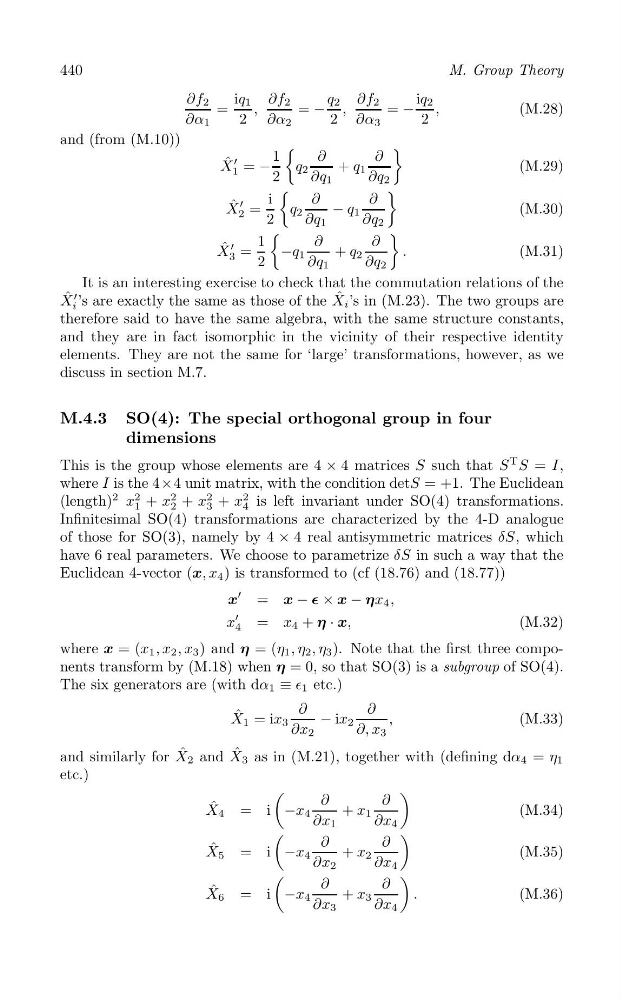
It is an interesting exercise to check that the commutation relations of the
X ˆ ′ ’s are exactly the same as those of the X ˆ i ’s in (M.23). The two groups are
i
therefore said to have the same algebra, with the same structure constants,
and they are in fact isomorphic in the vicinity of their respective identity
elements. They are not the same for ‘large’ transformations, however, as we
discuss in section M.7.
M.4.3 SO(4): The special orthogonal group in four
dimensions
This is the group whose elements are 4 × 4 matrices S such that S
T S = I,
where I is the 4×4 unit matrix, with the condition detS = +1. The Euclidean
2
2
2
2
(length)
2 x 1 + x 2 + x 3 + x is left invariant under SO(4) transformations.
4
Infinitesimal SO(4) transformations are characterized by the 4-D analogue
of those for SO(3), namely by 4 × 4 real antisymmetric matrices δS, which
have 6 real parameters. We choose to parametrize δS in such a way that the
Euclidean 4-vector (x, x 4 ) is transformed to (cf (18.76) and (18.77))
′
x = x − ∊ × x − ηx 4 ,
′
x = x 4 + η · x,
(M.32)
4
where x = (x 1 , x 2 , x 3 ) and η = (η 1 , η 2 , η 3 ). Note that the first three components transform by (M.18) when η = 0, so that SO(3) is a subgroup of SO(4).
The six generators are (with dα 1 ≡ ∊ 1 etc.)
∂
∂
ˆ
X 1 = ix 3
− ix 2
,
(M.33)
∂x 2
∂, x 3
and similarly for X ˆ 2 and X ˆ 3 as in (M.21), together with (defining dα 4 = η 1
etc.)
(
)
∂
∂
ˆ
X 4 = i −x 4
+ x 1
(M.34)
∂x 1
∂x 4
(
)
∂
∂
ˆ
X 5 = i −x 4
+ x 2
(M.35)
∂x 2
∂x 4
(
)
∂
∂
ˆ
X 6 = i −x 4
+ x 3
.
(M.36)
∂x 3
∂x 4