

M.4. Examples
439
(compare (12.64)), or
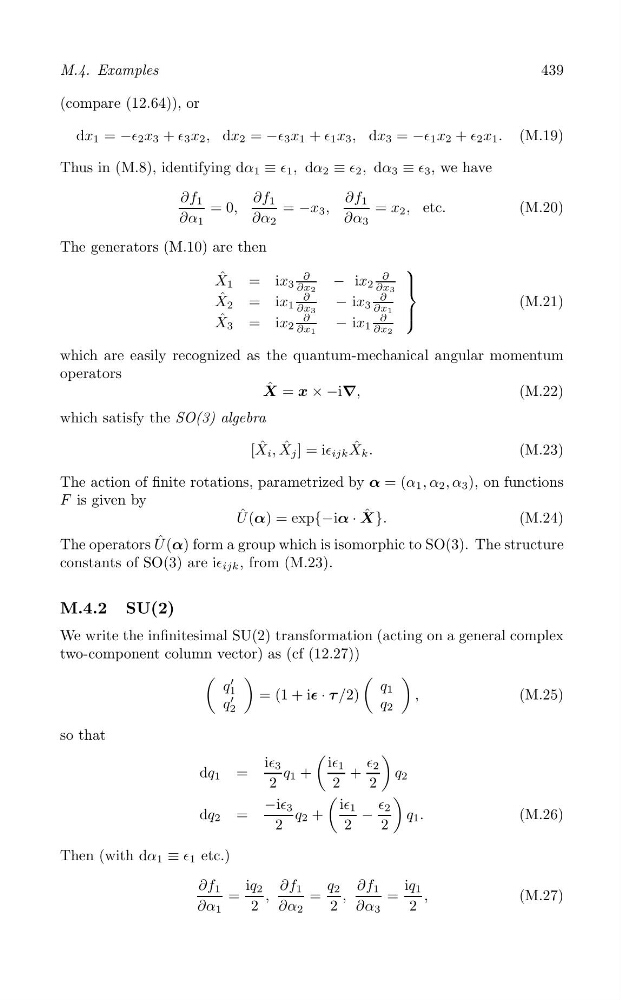
dx 1 = −∈ 2 x 3 + ∈ 3 x 2 , dx 2 = −∈ 3 x 1 + ∈ 1 x 3 , dx 3 = −∈ 1 x 2 + ∈ 2 x 1 . (M.19)
Thus in (M.8), identifying dα 1 ≡ ∈ 1 , dα 2 ≡ ∈ 2 , dα 3 ≡ ∈ 3 , we have
∂f 1
∂f 1
∂f
= 0,
−
1
= x 3 ,
= x 2 , etc.
(M.20)
∂α 1
∂α 2
∂α 3
The generators (M.10) are then
}
ˆ
X = ix
∂
− ix
∂
1
3
2
∂x2
∂x3 } '
ˆ
X 2 = ix
∂
1
ix
∂
3
(M.21)
∂x3
∂x1
ˆ
X = ix
∂
−
∂
} '
3
2 ∂x1
− ix 1 ∂x2
which are easily recognized as the quantum-mechanical angular momentum
operators
ˆ
X = x × −i∇,
(M.22)
which satisfy the SO(3) algebra
ˆ ˆ
ˆ
[X i , X j ] = i∈ ijk X k .
(M.23)
The action of finite rotations, parametrized by α = (α 1 , α 2 , α 3 ), on functions
F is given by
ˆ
U (α) = exp{−iα · ˆ
X}.
(M.24)
ˆ
The operators U (α) form a group which is isomorphic to SO(3). The structure
constants of SO(3) are i∈ ijk , from (M.23).
M.4.2 SU(2)
We write the infinitesimal SU(2) transformation (acting on a general complex
two-component column vector) as (cf (12.27))
(
)
(
)
q 1
′
q
= (1 + i∊ · τ /2)
1
,
(M.25)
q 2
′
q 2
so that
(
)
i∈ 3
i∈ 1
∈ 2
dq 1 =
q 1 +
+
q 2
2
2
2
(
)
dq 2 =
−i∈ 3
i∈ 1
∈ 2
q 2 +
2
2
−
q 1 .
(M.26)
2
Then (with dα 1 ≡ ∈ 1 etc.)
∂f 1
iq 2 ∂f 1
q 2 ∂f 1
iq 1
=
,
= ,
=
,
(M.27)
∂α 1
2 ∂α 2
2 ∂α 3
2