

438
M. Group Theory
r
ˆ
ˆ
where we have written ν=1 α ν X ν = α · X.
An important theorem states that the commutator of any two generators
of a Lie group is a linear combination of the generators:
ˆ ˆ
ˆ
[X λ , X μ ] = c
ν
λμ X ν ,
(M.12)
where the constants c
ν
λμ are complex numbers called the structure constants
of the group; a sum over ν from 1 to r is understood on the right-hand side.
The commutation relations (M.12) are called the algebra of the group.
M.4 Examples
M.4.1 SO(3) and three-dimensional rotations
Rotations in three dimensions are defined by
x
′ = R x,
(M.13)
where R is a real 3 × 3 matrix such that the length of x is preserved, i.e.
x
′T
x
′ = x
T
x. This implies that R
T R = I, so that R is an orthogonal matrix.
It follows that
1 = det(R
T R) = detR
T detR = (detR)
2 ,
(M.14)
and so detR = ±1. Those R’s with detR = −1 include a parity transformation
(x
′ = −x), which is not continuously connected to the identity. Those with
detR = 1 are ‘proper rotations’, and they form the elements of the group
SO(3): the S pecial O rthogonal group in 3 dimensions.
An R close to the identity matrix I can be written as R = I + δR where
(I + δR)
T (I + δR) = I.
(M.15)
Expanding this out to first order in δR gives
δR
T = −δR,
(M.16)
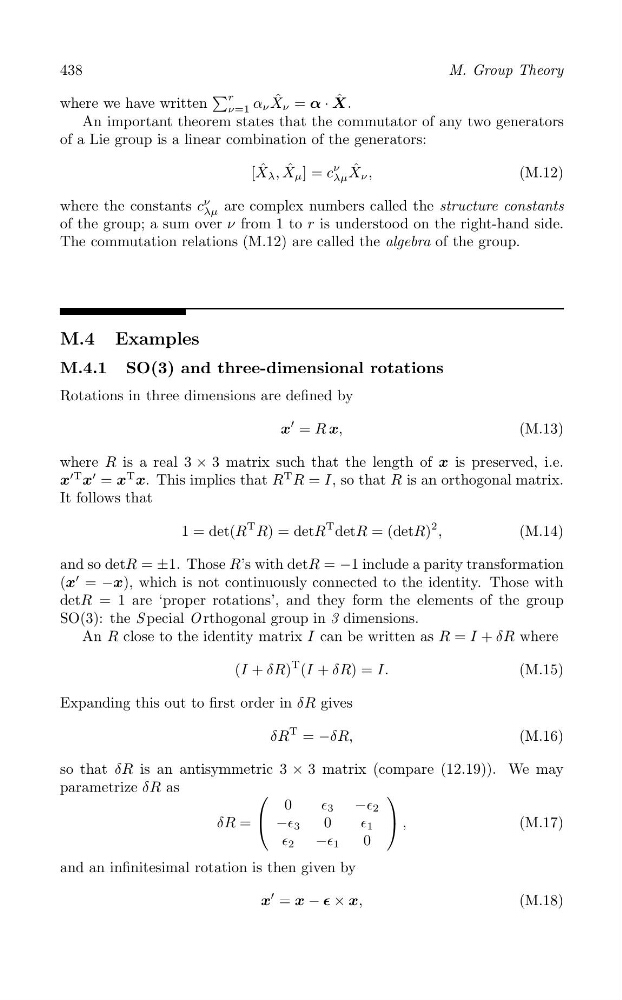
so that δR is an antisymmetric 3 × 3 matrix (compare (12.19)). We may
parametrize δR as
(
)
0
∈ 3 −∈ 2
δR = ( −∈ 3
0
∈ 1 ) ,
(M.17)
∈ 2 −∈ 1
0
and an infinitesimal rotation is then given by
x
′ = x − ∊ × x,
(M.18)
M. Group Theory
r
ˆ
ˆ
where we have written ν=1 α ν X ν = α · X.
An important theorem states that the commutator of any two generators
of a Lie group is a linear combination of the generators:
ˆ ˆ
ˆ
[X λ , X μ ] = c
ν
λμ X ν ,
(M.12)
where the constants c
ν
λμ are complex numbers called the structure constants
of the group; a sum over ν from 1 to r is understood on the right-hand side.
The commutation relations (M.12) are called the algebra of the group.
M.4 Examples
M.4.1 SO(3) and three-dimensional rotations
Rotations in three dimensions are defined by
x
′ = R x,
(M.13)
where R is a real 3 × 3 matrix such that the length of x is preserved, i.e.
x
′T
x
′ = x
T
x. This implies that R
T R = I, so that R is an orthogonal matrix.
It follows that
1 = det(R
T R) = detR
T detR = (detR)
2 ,
(M.14)
and so detR = ±1. Those R’s with detR = −1 include a parity transformation
(x
′ = −x), which is not continuously connected to the identity. Those with
detR = 1 are ‘proper rotations’, and they form the elements of the group
SO(3): the S pecial O rthogonal group in 3 dimensions.
An R close to the identity matrix I can be written as R = I + δR where
(I + δR)
T (I + δR) = I.
(M.15)
Expanding this out to first order in δR gives
δR
T = −δR,
(M.16)
so that δR is an antisymmetric 3 × 3 matrix (compare (12.19)). We may
parametrize δR as
(
)
0
∈ 3 −∈ 2
δR = ( −∈ 3
0
∈ 1 ) ,
(M.17)
∈ 2 −∈ 1
0
and an infinitesimal rotation is then given by
x
′ = x − ∊ × x,
(M.18)