

M.3. Generators of Lie groups
437
M.3 Generators of Lie groups
Consider (following Lichtenberg 1970, chapter 5) a group of transformations
defined by
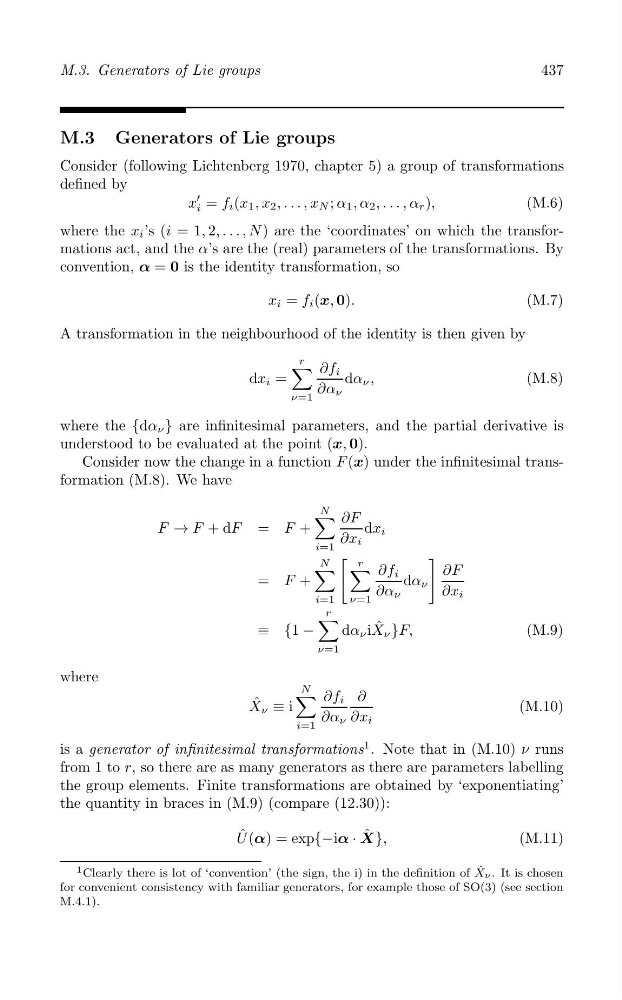
x
′
i = f i (x 1 , x 2 , . . . , x N ; α 1 , α 2 , . . . , α r ),
(M.6)
where the x i ’s (i = 1, 2, . . . , N) are the ‘coordinates’ on which the transformations act, and the α’s are the (real) parameters of the transformations. By
convention, α = 0 is the identity transformation, so
x i = f i (x, 0).
(M.7)
A transformation in the neighbourhood of the identity is then given by
∑ r ∂f i
dx i =
dα ν ,
(M.8)
∂α ν
ν=1
where the {dα ν } are infinitesimal parameters, and the partial derivative is
understood to be evaluated at the point (x, 0).
Consider now the change in a function F (x) under the infinitesimal transformation (M.8). We have
∑ N ∂F
F → F + dF = F +
dx i
∂x i
i=1 [
]
∑ N ∑ r ∂f i
∂F
= F +
dα ν
∂α ν
∂x i
i=1 ν=1
∑ r
≡ {1 −
ˆ
dα ν iX ν
ν=1
}F,
(M.9)
where
∑ N ∂f
ˆ ≡
i ∂
X ν i
(M.10)
∂α ν ∂x i
i=1
is a generator of infinitesimal transformations
1 . Note that in (M.10) ν runs
from 1 to r, so there are as many generators as there are parameters labelling
the group elements. Finite transformations are obtained by ‘exponentiating’
the quantity in braces in (M.9) (compare (12.30)):
ˆ
U (α) = exp{−iα · ˆ
X},
(M.11)
1 Clearly there is lot of ‘convention’ (the sign, the i) in the definition of X ˆ ν . It is chosen
for convenient consistency with familiar generators, for example those of SO(3) (see section
M.4.1).