

429
22.8. The Higgs sector
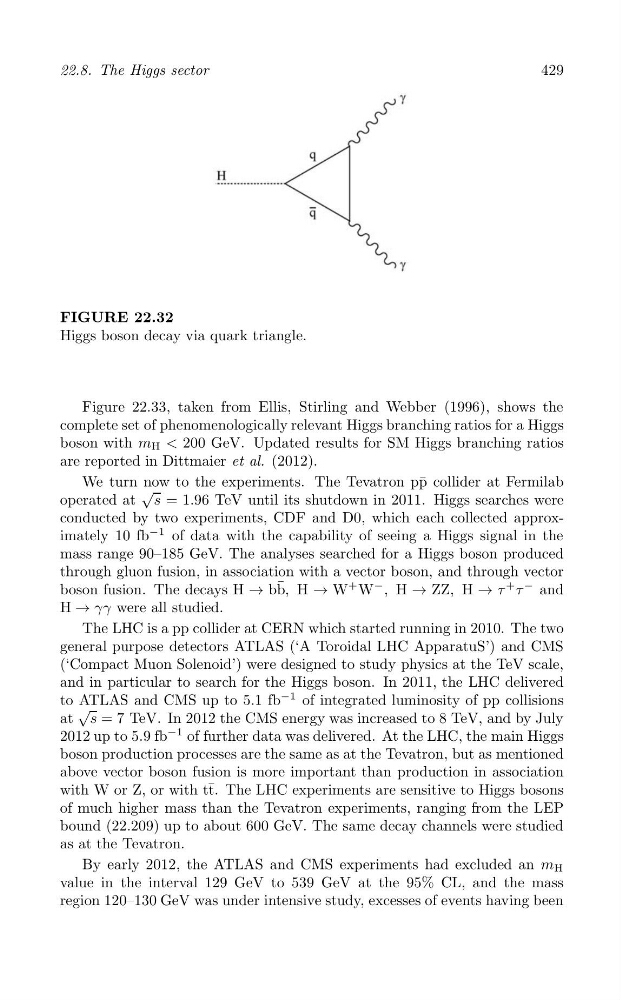
FIGURE 22.32
Higgs boson decay via quark triangle.
Figure 22.33, taken from Ellis, Stirling and Webber (1996), shows the
complete set of phenomenologically relevant Higgs branching ratios for a Higgs
boson with m H < 200 GeV. Updated results for SM Higgs branching ratios
are reported in Dittmaier et al. (2012).
We turn now to the experiments. The Tevatron p¯ p collider at Fermilab
√
operated at s = 1.96 TeV until its shutdown in 2011. Higgs searches were
conducted by two experiments, CDF and D0, which each collected approximately 10 fb
−1 of data with the capability of seeing a Higgs signal in the
mass range 90–185 GeV. The analyses searched for a Higgs boson produced
through gluon fusion, in association with a vector boson, and through vector
boson fusion. The decays H → bb ¯ , H → W
+ W
− , H → ZZ, H → τ
+ τ
− and
H → γγ were all studied.
The LHC is a pp collider at CERN which started running in 2010. The two
general purpose detectors ATLAS (‘A Toroidal LHC ApparatuS’) and CMS
(‘Compact Muon Solenoid’) were designed to study physics at the TeV scale,
and in particular to search for the Higgs boson. In 2011, the LHC delivered
to ATLAS and CMS up to 5.1 fb
−1 of integrated luminosity of pp collisions
√
at s = 7 TeV. In 2012 the CMS energy was increased to 8 TeV, and by July
2012 up to 5.9 fb
−1 of further data was delivered. At the LHC, the main Higgs
boson production processes are the same as at the Tevatron, but as mentioned
above vector boson fusion is more important than production in association
with W or Z, or with t ¯ t. The LHC experiments are sensitive to Higgs bosons
of much higher mass than the Tevatron experiments, ranging from the LEP
bound (22.209) up to about 600 GeV. The same decay channels were studied
as at the Tevatron.
By early 2012, the ATLAS and CMS experiments had excluded an m H
value in the interval 129 GeV to 539 GeV at the 95% CL, and the mass
region 120–130 GeV was under intensive study, excesses of events having been