

428
22. The GSW Gauge Theory of Electroweak Interactions
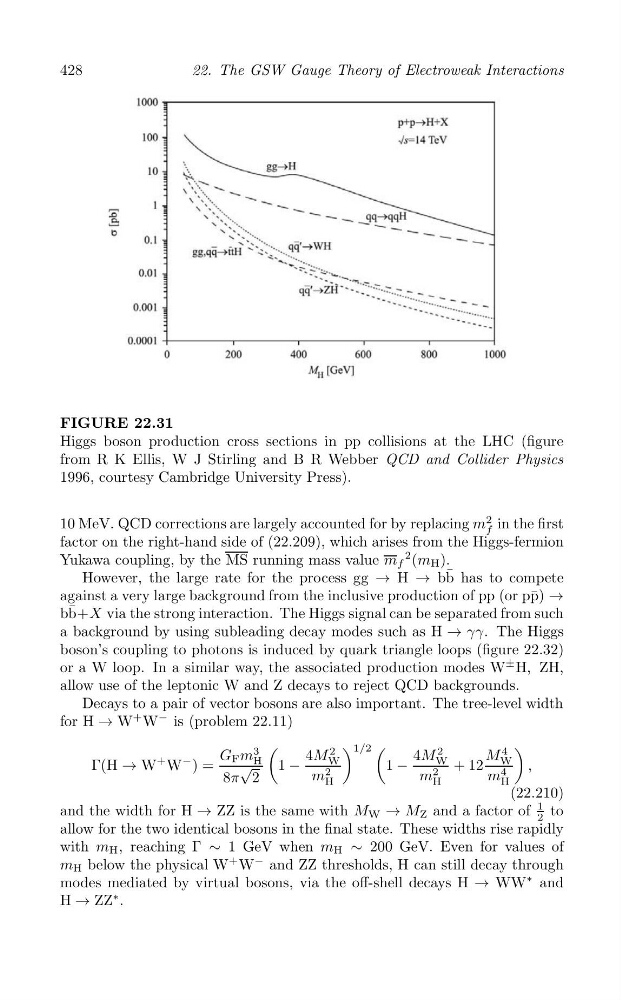
FIGURE 22.31
Higgs boson production cross sections in pp collisions at the LHC (figure
from R K Ellis, W J Stirling and B R Webber QCD and Collider Physics
1996, courtesy Cambridge University Press).
2
10 MeV. QCD corrections are largely accounted for by replacing m in the first
f
factor on the right-hand side of (22.209), which arises from the Higgs-fermion
Yukawa coupling, by the MS running mass value m f
2 (m H ).
However, the large rate for the process gg → H → b ¯
b has to compete
against a very large background from the inclusive production of pp (or p¯ p) →
b ¯
b+X via the strong interaction. The Higgs signal can be separated from such
a background by using subleading decay modes such as H → γγ. The Higgs
boson’s coupling to photons is induced by quark triangle loops (figure 22.32)
or a W loop. In a similar way, the associated production modes W
± H, ZH,
allow use of the leptonic W and Z decays to reject QCD backgrounds.
Decays to a pair of vector bosons are also important. The tree-level width
for H → W
+ W
− is (problem 22.11)
(
) 1/2 (
)
3
G F m
4M
2
4M
2
M
4
H
W
W
W
Γ(H → W
+ W
− ) =
√
1 −
1 −
+ 12
,
2
2
4
H
H
H
8π 2
m
m
m
(22.210)
and the width for H → ZZ is the same with M W → M Z and a factor of
1 to
allow for the two identical bosons in the final state. These widths rise rapidly
with m H , reaching Γ ∼ 1 GeV when m H ∼ 200 GeV. Even for values of
m H below the physical W
+ W
− and ZZ thresholds, H can still decay through
modes mediated by virtual bosons, via the off-shell decays H → WW
∗ and
H → ZZ
∗ .
2