

427
22.8. The Higgs sector
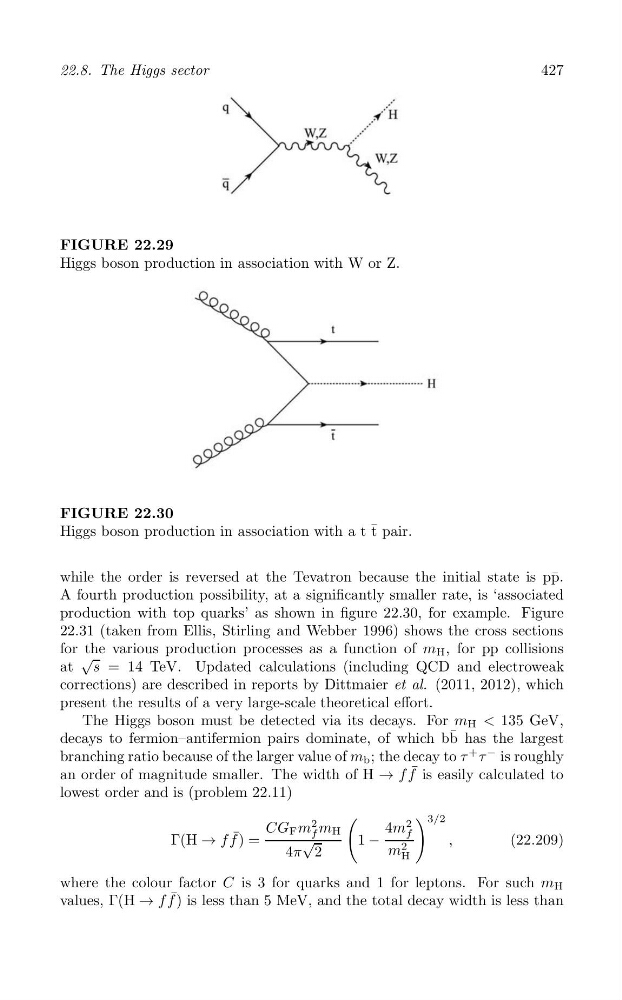
FIGURE 22.29
Higgs boson production in association with W or Z.
FIGURE 22.30
Higgs boson production in association with a t ¯ t pair.
while the order is reversed at the Tevatron because the initial state is p¯ p.
A fourth production possibility, at a significantly smaller rate, is ‘associated
production with top quarks’ as shown in figure 22.30, for example. Figure
22.31 (taken from Ellis, Stirling and Webber 1996) shows the cross sections
for the various production processes as a function of m H , for pp collisions
√
at s = 14 TeV. Updated calculations (including QCD and electroweak
corrections) are described in reports by Dittmaier et al. (2011, 2012), which
present the results of a very large-scale theoretical effort.
The Higgs boson must be detected via its decays. For m H < 135 GeV,
decays to fermion–antifermion pairs dominate, of which b ¯
b has the largest
branching ratio because of the larger value of m b ; the decay to τ
+ τ
− is roughly
¯
an order of magnitude smaller. The width of H → f f is easily calculated to
lowest order and is (problem 22.11)
(
) 3/2
CG F m
2
4m
2
f m H
f
¯
Γ(H → f f ) =
√
1 −
,
(22.209)
2
4π 2
m H
where the colour factor C is 3 for quarks and 1 for leptons. For such m H
¯
values, Γ(H → f f ) is less than 5 MeV, and the total decay width is less than