

430
22. The GSW Gauge Theory of Electroweak Interactions
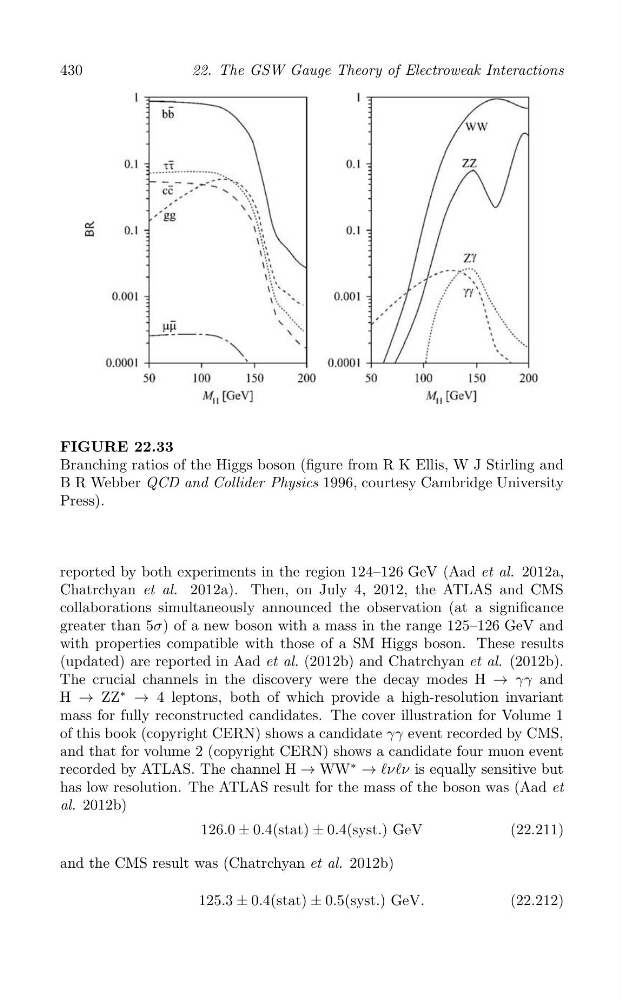
FIGURE 22.33
Branching ratios of the Higgs boson (figure from R K Ellis, W J Stirling and
B R Webber QCD and Collider Physics 1996, courtesy Cambridge University
Press).
reported by both experiments in the region 124–126 GeV (Aad et al. 2012a,
Chatrchyan et al. 2012a). Then, on July 4, 2012, the ATLAS and CMS
collaborations simultaneously announced the observation (at a significance
greater than 5σ) of a new boson with a mass in the range 125–126 GeV and
with properties compatible with those of a SM Higgs boson. These results
(updated) are reported in Aad et al. (2012b) and Chatrchyan et al. (2012b).
The crucial channels in the discovery were the decay modes H → γγ and
H → ZZ
∗
→ 4 leptons, both of which provide a high-resolution invariant
mass for fully reconstructed candidates. The cover illustration for Volume 1
of this book (copyright CERN) shows a candidate γγ event recorded by CMS,
and that for volume 2 (copyright CERN) shows a candidate four muon event
recorded by ATLAS. The channel H → WW
∗
→ eνeν is equally sensitive but
has low resolution. The ATLAS result for the mass of the boson was (Aad et
al. 2012b)
126.0 ± 0.4(stat) ± 0.4(syst.) GeV
(22.211)
and the CMS result was (Chatrchyan et al. 2012b)
125.3 ± 0.4(stat) ± 0.5(syst.) GeV.
(22.212)