

418
22. The GSW Gauge Theory of Electroweak Interactions
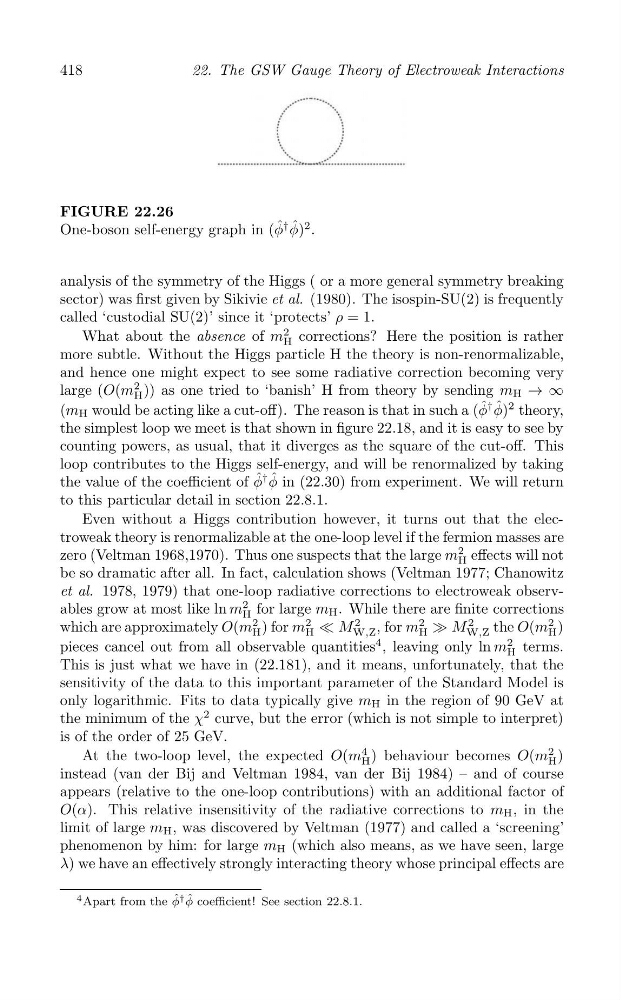
FIGURE 22.26
One-boson self-energy graph in (φ ˆ† φ ˆ )
2 .
analysis of the symmetry of the Higgs ( or a more general symmetry breaking
sector) was first given by Sikivie et al. (1980). The isospin-SU(2) is frequently
called ‘custodial SU(2)’ since it ‘protects’ ρ = 1.
What about the absence of m
2
H corrections? Here the position is rather
more subtle. Without the Higgs particle H the theory is non-renormalizable,
and hence one might expect to see some radiative correction becoming very
large (O(m
2
H )) as one tried to ‘banish’ H from theory by sending m H → ∞
(m H would be acting like a cut-off). The reason is that in such a (φ ˆ† φ ˆ )
2 theory,
the simplest loop we meet is that shown in figure 22.18, and it is easy to see by
counting powers, as usual, that it diverges as the square of the cut-off. This
loop contributes to the Higgs self-energy, and will be renormalized by taking
the value of the coefficient of φ ˆ † φ ˆ in (22.30) from experiment. We will return
to this particular detail in section 22.8.1.
Even without a Higgs contribution however, it turns out that the electroweak theory is renormalizable at the one-loop level if the fermion masses are
zero (Veltman 1968,1970). Thus one suspects that the large m
2
H effects will not
be so dramatic after all. In fact, calculation shows (Veltman 1977; Chanowitz
et al. 1978, 1979) that one-loop radiative corrections to electroweak observables grow at most like ln m
2
H for large m H . While there are finite corrections
which are approximately O(m
2
H ) for m
2
H ≪ M
2
W,Z , for m
2
H ≫ M
2
W,Z the O(m
2
H )
pieces cancel out from all observable quantities
4 , leaving only ln m
2
H terms.
This is just what we have in (22.181), and it means, unfortunately, that the
sensitivity of the data to this important parameter of the Standard Model is
only logarithmic. Fits to data typically give m H in the region of 90 GeV at
the minimum of the χ
2 curve, but the error (which is not simple to interpret)
is of the order of 25 GeV.
At the two-loop level, the expected O(m
4
H ) behaviour becomes O(m
2
H )
instead (van der Bij and Veltman 1984, van der Bij 1984) – and of course
appears (relative to the one-loop contributions) with an additional factor of
O(α). This relative insensitivity of the radiative corrections to m H , in the
limit of large m H , was discovered by Veltman (1977) and called a ‘screening’
phenomenon by him: for large m H (which also means, as we have seen, large
λ) we have an effectively strongly interacting theory whose principal effects are
4 Apart from the φ ˆ† φ ˆ coefficient! See section 22.8.1.