

417
22.6. Higher-order corrections
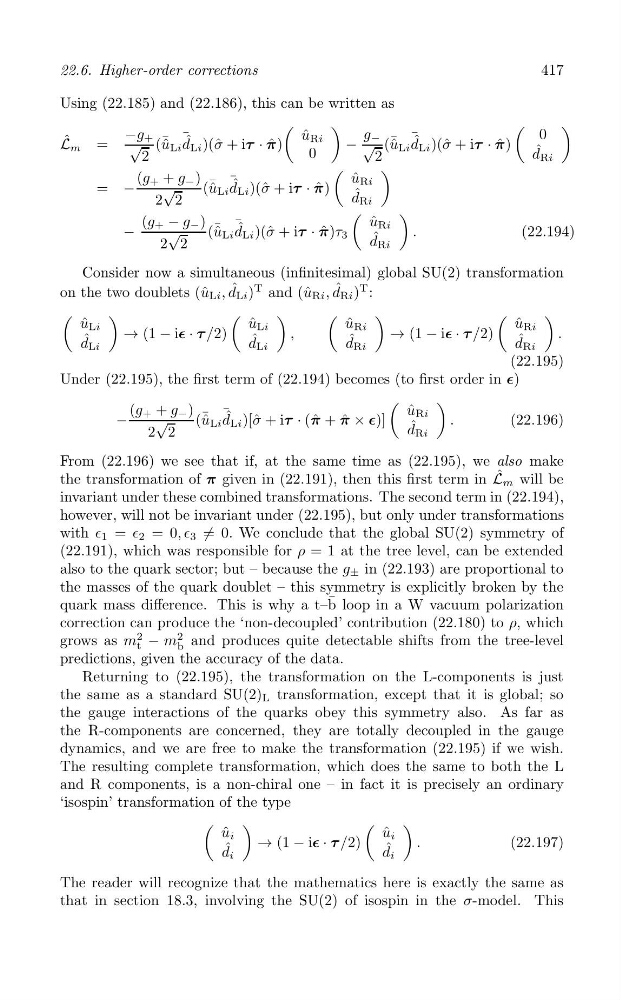
Using (22.185) and (22.186), this can be written as
(
)
(
)
ˆ
−g +
¯ ˆ
u ˆ Ri
g −
¯
0
ˆ
L m = √ (u ¯ ˆ Li d Li )(ˆ σ + iτ · π ˆ )
− √ (u ¯ ˆ Li d Li )(ˆ σ + iτ · π ˆ )
ˆ
2
2
d Ri
0 (
)
(g + + g − )
¯
u ˆ Ri
= −
√
(u ¯ ˆ Li d ˆ Li )(ˆ σ + iτ · π ˆ )
ˆ
2 2
d Ri
(
)
(g + − g − )
¯
u ˆ Ri
−
√
(u ¯ ˆ Li d ˆ Li )(ˆ σ + iτ · π ˆ )τ 3
ˆ
.
(22.194)
2 2
d Ri
Consider now a simultaneous (infinitesimal) global SU(2) transformation
on the two doublets (ˆ u Li , d ˆ Li )
T and (ˆ u Ri , d ˆ Ri )
T :
(
)
(
)
(
)
(
)
u ˆ Li
u ˆ Li
u ˆ Ri
u ˆ Ri
→ (1 − i∊ · τ /2)
,
→ (1 − i∊ · τ /2)
.
ˆ
ˆ
ˆ
ˆ
d Li
d Li
d Ri
d Ri
(22.195)
Under (22.195), the first term of (22.194) becomes (to first order in ∊)
(
)
(g + + g − )
¯ ˆ
u ˆ Ri
−
√
(u ¯ ˆ Li d Li )[ˆ σ + iτ · (π ˆ + π ˆ × ∊)]
ˆ
.
(22.196)
2 2
d Ri
From (22.196) we see that if, at the same time as (22.195), we also make
the transformation of π given in (22.191), then this first term in L ˆ m will be
invariant under these combined transformations. The second term in (22.194),
however, will not be invariant under (22.195), but only under transformations
with ∈ 1 = ∈ 2 = 0, ∈ 3 / = 0. We conclude that the global SU(2) symmetry of
(22.191), which was responsible for ρ = 1 at the tree level, can be extended
also to the quark sector; but – because the g ± in (22.193) are proportional to
the masses of the quark doublet – this symmetry is explicitly broken by the
quark mass difference. This is why a t– ¯
b loop in a W vacuum polarization
correction can produce the ‘non-decoupled’ contribution (22.180) to ρ, which
2
2
grows as m − m and produces quite detectable shifts from the tree-level
t
b
predictions, given the accuracy of the data.
Returning to (22.195), the transformation on the L-components is just
the same as a standard SU(2) L transformation, except that it is global; so
the gauge interactions of the quarks obey this symmetry also. As far as
the R-components are concerned, they are totally decoupled in the gauge
dynamics, and we are free to make the transformation (22.195) if we wish.
The resulting complete transformation, which does the same to both the L
and R components, is a non-chiral one – in fact it is precisely an ordinary
‘isospin’ transformation of the type
(
)
(
)
u ˆ i
u ˆ i
→ (1 − i∊ · τ /2)
.
(22.197)
ˆ
ˆ
d i
d i
The reader will recognize that the mathematics here is exactly the same as
that in section 18.3, involving the SU(2) of isospin in the σ-model. This