

416
22. The GSW Gauge Theory of Electroweak Interactions
Higgs field (22.185), and indeed the notation suggests that W ˆ μ and π ˆ should
perhaps be regarded as some kind of new triplets.
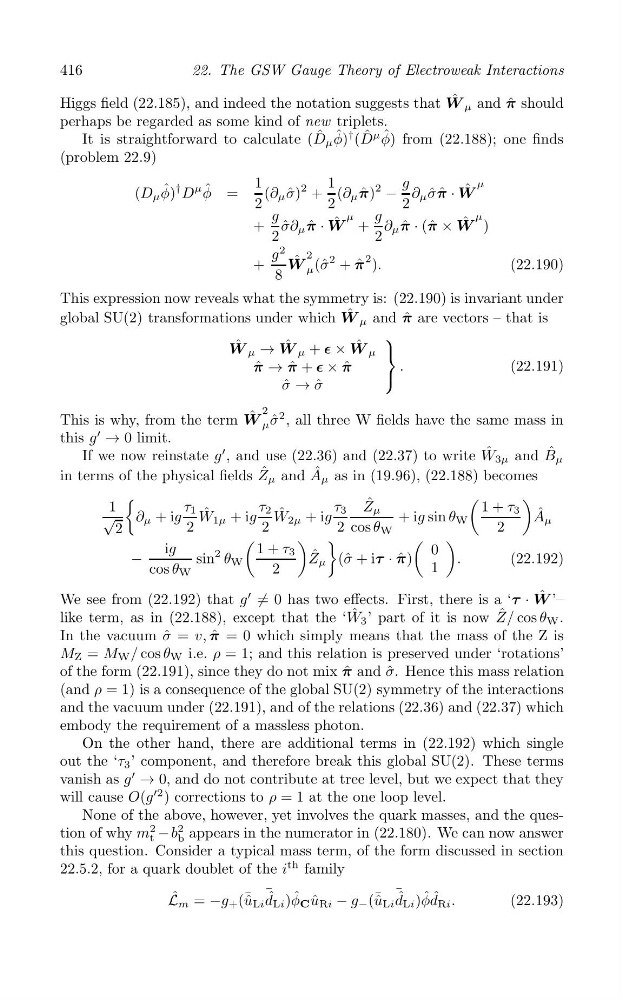
It is straightforward to calculate (D ˆ μ φ ˆ )
† (D ˆ μ φ ˆ ) from (22.188); one finds
(problem 22.9)
1
1
g
μ
(D μ φ ˆ )
† D
μ φ ˆ =
(∂ μ σ ˆ)
2 + (∂ μ π ˆ )
2
− ∂ μ σ ˆπ ˆ · W ˆ
2
2
2
g
μ
g
μ
+ ˆ π ·
+
σ∂ μ ˆ W ˆ
∂ μ π ˆ · π × ˆ )
( ˆ W
2
2
g
2
2
ˆ σ
2
π
2
+
W μ (ˆ + ˆ ).
(22.190)
8
This expression now reveals what the symmetry is: (22.190) is invariant under
global SU(2) transformations under which ˆ
π are vectors that is
W μ and ˆ
–
ˆ
W μ + ∊ × ˆ
W μ → ˆ
W μ
}
}
π ˆ → π ˆ + ∊ × π ˆ
.
(22.191)
}
σ ˆ → σ ˆ
2
This is why, from the term ˆ
μ σ ˆ
2 , all three W fields have the same mass in
W
′
this g → 0 limit.
If we now reinstate g
′ , and use (22.36) and (22.37) to write W ˆ 3μ and B ˆ μ
in terms of the physical fields Z ˆ μ and A ˆ μ as in (19.96), (22.188) becomes
(
(
)
ˆ
1
τ 1
τ 2
τ 3 Z μ
1 + τ 3
ˆ
ˆ
ˆ
√ ∂ μ + ig W 1μ + ig W 2μ + ig
+ ig sin θ W
A μ
2
2
2
2 cos θ W
2
(
) )
(
)
ig
1 + τ 3
0
−
sin
2 θ W
Z ˆ μ (ˆ σ + iτ · π ˆ )
.
(22.192)
cos θ W
2
1
′
ˆ
We see from (22.192) that g / 0 has two effects. First, there is a ‘τ ·
=
W ’–
like term, as in (22.188), except that the ‘W ˆ 3 ’ part of it is now ˆ
Z/ cos θ W .
In the vacuum ˆ
σ = v, π ˆ = 0 which simply means that the mass of the Z is
M Z = M W / cos θ W i.e. ρ = 1; and this relation is preserved under ‘rotations’
of the form (22.191), since they do not mix π ˆ and ˆ
σ. Hence this mass relation
(and ρ = 1) is a consequence of the global SU(2) symmetry of the interactions
and the vacuum under (22.191), and of the relations (22.36) and (22.37) which
embody the requirement of a massless photon.
On the other hand, there are additional terms in (22.192) which single
out the ‘τ 3 ’ component, and therefore break this global SU(2). These terms
′
vanish as g → 0, and do not contribute at tree level, but we expect that they
will cause O(g
′2 ) corrections to ρ = 1 at the one loop level.
None of the above, however, yet involves the quark masses, and the ques2
tion of why m − b b
2 appears in the numerator in (22.180). We can now answer
t
this question. Consider a typical mass term, of the form discussed in section
22.5.2, for a quark doublet of the i
th family
ˆ
¯
¯
L m = −g + (u ¯ ˆ Li d ˆ Li )φ ˆ C u ˆ Ri − g − (u ¯ ˆ Li d ˆ Li )φ ˆ d ˆ Ri .
(22.193)