

22.6. Higher-order corrections
415
ˆ
Lagrangian L GΦ of (22.30) which produced the gauge boson masses. With
the doublet Higgs of the form (22.131), it is a striking fact that the Higgs
potential only involves the highly symmetrical combination of fields
ˆ
φ
2
ˆ
+ φ
2
ˆ
ˆ
+ φ
2
2
1
2
3 + φ 4 ,
(22.184)
as does the vacuum condition (17.102). This suggests that there may be
some extra symmetry in (22.30) which is special to the doublet structure.
But of course, to be of any interest, this symmetry has to be present in the
ˆ ˆ
(D μ φ)
† ˆ
(D
μ ˆ
φ) term as well.
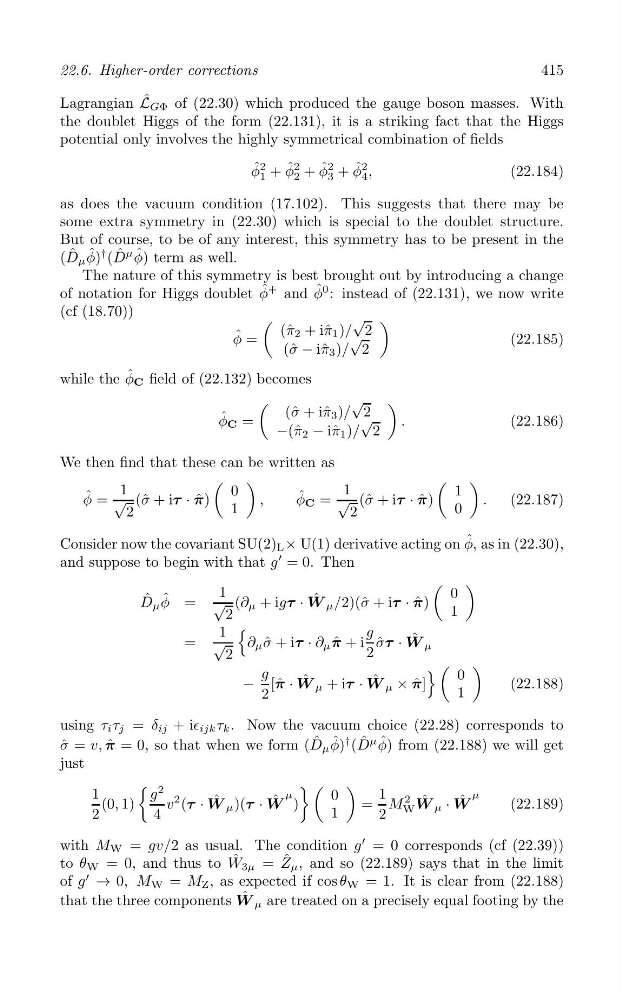
The nature of this symmetry is best brought out by introducing a change
ˆ
of notation for Higgs doublet φ
+
ˆ
and φ
0 : instead of (22.131), we now write
(cf (18.70))
(
√ )
(ˆ π 2 + iπ ˆ )
φ =
1 / 2
ˆ
(ˆ σ − iˆ π 3 )/
√
(22.185)
2
ˆ
while the φ C field of (22.132) becomes
(
/
√
)
(ˆ σ + iπ ˆ ) 2
ˆ
φ =
3
C
√
.
(22.186)
−(ˆ π 2 − iˆ π 1 )/ 2
We then find that these can be written as
(
)
(
)
1
0
1
1
ˆ
φ = √ (ˆ σ + iτ · π ˆ
ˆ
)
,
φ C =
2
√ (ˆ σ + iτ · π ˆ )
.
(22.187)
1
2
0
ˆ
Consider now the covariant SU(2) L × U(1) derivative acting on φ, as in (22.30),
and suppose to begin with that g
′ = 0. Then
(
)
1
0
ˆ ˆ
ˆ
D μ φ = √ (∂ μ + igτ · W μ /2)(σ ˆ + iτ · π ˆ )
2
1
{
1
g
ˆ
= √ ∂ μ σ ˆ + iτ · ∂ μ π ˆ + i σ ˆτ · W μ
2
2
} ( )
g
0
−
ˆ
π ˆ · W μ + iτ · ˆ
[
W μ × π ˆ ]
(22.188)
2
1
using τ i τ j = δ ij + i∈ ijk τ k . Now the vacuum choice (22.28) corresponds to
ˆ ˆ ˆ ˆ
σ ˆ = v, π ˆ = 0, so that when we form (D φ)
† (D
μ
μ
φ) from (22.188) we will get
just
(
) ( )
1
g
2
ˆ
ˆ
μ
2
0
1
ˆ
ˆ
μ
(0, 1)
v (τ · W
2
μ )(τ · W )
= M
2
4
1
2
W W μ · W
(22.189)
with M W = gv/2 as usual. The condition g
′ = 0 corresponds (cf (22.39))
ˆ
ˆ
to θ W = 0, and thus to W 3μ = Z μ , and so (22.189) says that in the limit
of g
′
→ 0, M W = M Z , as expected if cos θ W = 1. It is clear from (22.188)
ˆ
that the three components W μ are treated on a precisely equal footing by the