

414
22. The GSW Gauge Theory of Electroweak Interactions
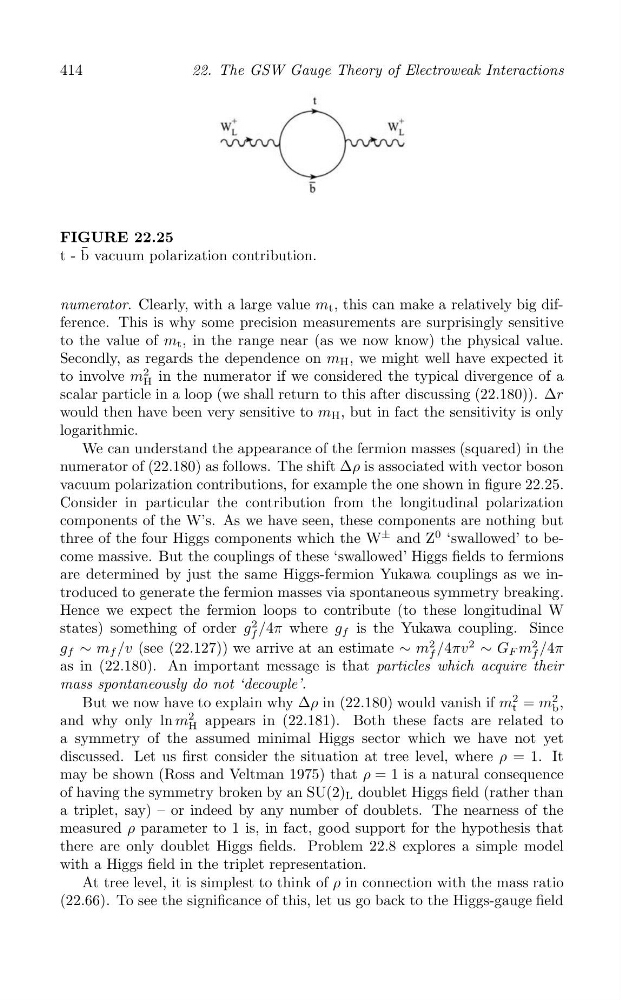
FIGURE 22.25
t - ¯
b vacuum polarization contribution.
numerator. Clearly, with a large value m t , this can make a relatively big difference. This is why some precision measurements are surprisingly sensitive
to the value of m t , in the range near (as we now know) the physical value.
Secondly, as regards the dependence on m H , we might well have expected it
2
to involve m in the numerator if we considered the typical divergence of a
H
scalar particle in a loop (we shall return to this after discussing (22.180)). Δr
would then have been very sensitive to m H , but in fact the sensitivity is only
logarithmic.
We can understand the appearance of the fermion masses (squared) in the
numerator of (22.180) as follows. The shift Δρ is associated with vector boson
vacuum polarization contributions, for example the one shown in figure 22.25.
Consider in particular the contribution from the longitudinal polarization
components of the W’s. As we have seen, these components are nothing but
three of the four Higgs components which the W
± and Z
0 ‘swallowed’ to become massive. But the couplings of these ‘swallowed’ Higgs fields to fermions
are determined by just the same Higgs-fermion Yukawa couplings as we introduced to generate the fermion masses via spontaneous symmetry breaking.
Hence we expect the fermion loops to contribute (to these longitudinal W
2
states) something of order g /4π where g f is the Yukawa coupling. Since
f
2
2
g f ∼ m f /v (see (22.127)) we arrive at an estimate ∼ m /4πv
2
∼ G F m /4π
f
f
as in (22.180). An important message is that particles which acquire their
mass spontaneously do not ‘decouple’.
2
2
But we now have to explain why Δρ in (22.180) would vanish if m = m
t
b ,
2
and why only ln m appears in (22.181). Both these facts are related to
H
a symmetry of the assumed minimal Higgs sector which we have not yet
discussed. Let us first consider the situation at tree level, where ρ = 1. It
may be shown (Ross and Veltman 1975) that ρ = 1 is a natural consequence
of having the symmetry broken by an SU(2) L doublet Higgs field (rather than
a triplet, say) – or indeed by any number of doublets. The nearness of the
measured ρ parameter to 1 is, in fact, good support for the hypothesis that
there are only doublet Higgs fields. Problem 22.8 explores a simple model
with a Higgs field in the triplet representation.
At tree level, it is simplest to think of ρ in connection with the mass ratio
(22.66). To see the significance of this, let us go back to the Higgs-gauge field