

413
22.6. Higher-order corrections
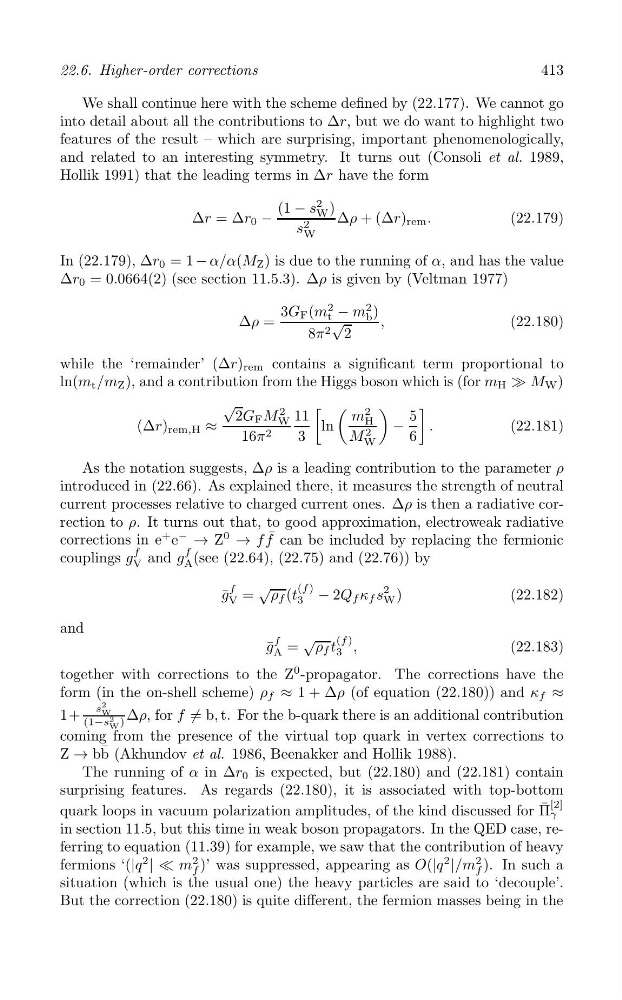
We shall continue here with the scheme defined by (22.177). We cannot go
into detail about all the contributions to Δr, but we do want to highlight two
features of the result – which are surprising, important phenomenologically,
and related to an interesting symmetry. It turns out (Consoli et al. 1989,
Hollik 1991) that the leading terms in Δr have the form
2
(1 − s )
W
Δr = Δr 0 −
Δρ + (Δr) rem .
(22.179)
2
s W
In (22.179), Δr 0 = 1 − α/α(M Z ) is due to the running of α, and has the value
Δr 0 = 0.0664(2) (see section 11.5.3). Δρ is given by (Veltman 1977)
2
2
3G F (m t − m )
b
Δρ =
√
,
(22.180)
8π 2 2
while the ‘remainder’ (Δr) rem contains a significant term proportional to
ln(m t /m Z ), and a contribution from the Higgs boson which is (for m H ≫ M W )
√
[ (
)
]
2
2G F M
2 11
m
5
W
H
(Δr) rem,H ≈
ln
−
.
(22.181)
16π 2
3
M 2
6
W
As the notation suggests, Δρ is a leading contribution to the parameter ρ
introduced in (22.66). As explained there, it measures the strength of neutral
current processes relative to charged current ones. Δρ is then a radiative correction to ρ. It turns out that, to good approximation, electroweak radiative
−
¯
corrections in e
+ e → Z
0
→ f f can be included by replacing the fermionic
f
f
couplings g and g (see (22.64), (22.75) and (22.76)) by
V
A
f
√
(f )
2
g ¯ = ρ f (t − 2Q f κ f s W )
(22.182)
V
3
and
f
√ (f )
g ¯ A = ρ f t 3 ,
(22.183)
together with corrections to the Z
0 -propagator. The corrections have the
form (in the on-shell scheme) ρ f ≈ 1 + Δρ (of equation (22.180)) and κ f ≈
1+
s
2
W
(1−s 2
W )
Δρ, for f /
an
= b, t. For the b-quark there is
additional contribution
coming from the presence of the virtual top quark in vertex corrections to
Z → b ¯
b (Akhundov et al. 1986, Beenakker and Hollik 1988).
The running of α in Δr 0 is expected, but (22.180) and (22.181) contain
surprising features. As regards (22.180), it is associated with top-bottom
quark loops in vacuum polarization amplitudes, of the kind discussed for Π ¯ [2]
γ
in section 11.5, but this time in weak boson propagators. In the QED case, referring to equation (11.39) for example, we saw that the contribution of heavy
2
fermions ‘(|q
2
| ≪ m )’ was suppressed, appearing as O(|q
2
|/m
2 ). In such a
f
f
situation (which is the usual one) the heavy particles are said to ‘decouple’.
But the correction (22.180) is quite different, the fermion masses being in the