

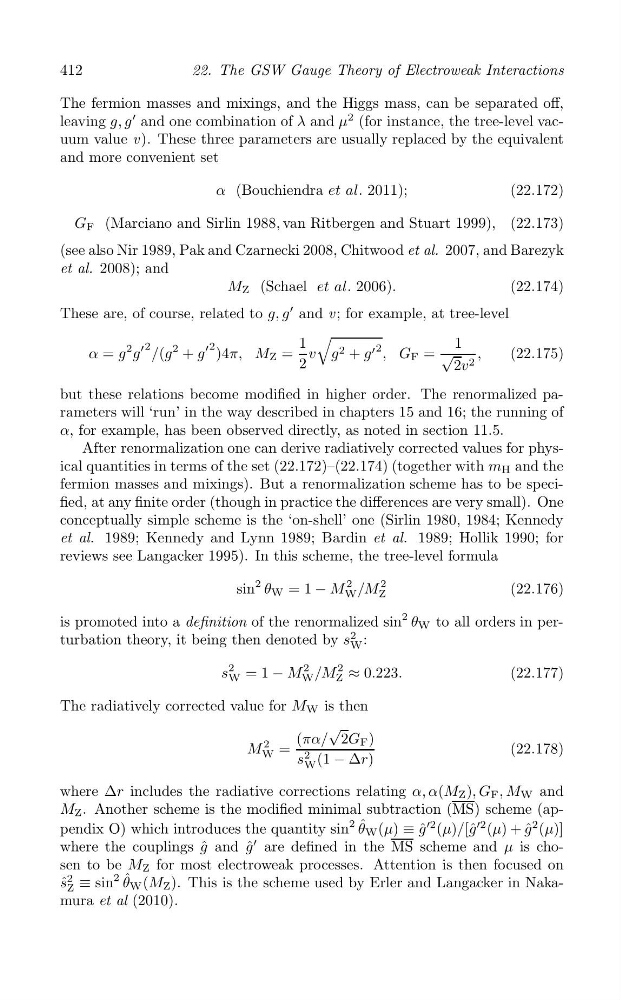
412
22. The GSW Gauge Theory of Electroweak Interactions
The fermion masses and mixings, and the Higgs mass, can be separated off,
leaving g, g
′ and one combination of λ and μ
2 (for instance, the tree-level vacuum value v ). These three parameters are usually replaced by the equivalent
and more convenient set
α (Bouchiendra et al. 2011);
(22.172)
G F (Marciano and Sirlin 1988, van Ritbergen and Stuart 1999), (22.173)
(see also Nir 1989, Pak and Czarnecki 2008, Chitwood et al. 2007, and Barezyk
et al. 2008); and
M Z (Schael et al. 2006).
(22.174)
These are, of course, related to g, g
′ and v ; for example, at tree-level
√
2
2
1
1
α = g
2 g
′ /(g
2 + g
′ )4π, M Z = v g 2 + g ′ 2 , G F = √
,
(22.175)
2
2v 2
but these relations become modified in higher order. The renormalized parameters will ‘run’ in the way described in chapters 15 and 16; the running of
α, for example, has been observed directly, as noted in section 11.5.
After renormalization one can derive radiatively corrected values for physical quantities in terms of the set (22.172)–(22.174) (together with m H and the
fermion masses and mixings). But a renormalization scheme has to be specified, at any finite order (though in practice the differences are very small). One
conceptually simple scheme is the ‘on-shell’ one (Sirlin 1980, 1984; Kennedy
et al. 1989; Kennedy and Lynn 1989; Bardin et al. 1989; Hollik 1990; for
reviews see Langacker 1995). In this scheme, the tree-level formula
sin
2 θ = 1 − M
2 /M
2
W
W
Z
(22.176)
is promoted into a definition of the renormalized sin
2 θ W to all orders in perturbation theory, it being then denoted by s
2
W :
s
2
2
2
W = 1 − M W /M Z ≈ 0.223.
(22.177)
The radiatively corrected value for M W is then
2
(πα/
√
2G F )
M W =
(22.178)
s 2
W (1 − Δr)
where Δr includes the radiative corrections relating α, α(M Z ), G F , M W and
M Z . Another scheme is the modified minimal subtraction (MS) scheme (apˆ
pendix O) which introduces the quantity sin
2 θ (μ) ≡ g ˆ
′2 (μ)/[ˆ g
′2
W
(μ) + g ˆ
2 (μ)]
where the couplings g ˆ and g ˆ
′ are defined in the MS scheme and μ is chosen to be M Z for most electroweak processes. Attention is then focused on
s ˆ
2
Z ≡ sin
2 ˆ
θ W (M Z ). This is the scheme used by Erler and Langacker in Nakamura et al (2010).