

392
22. The GSW Gauge Theory of Electroweak Interactions
However, QED alone produces a small positive A FB , through interference
between 1γ and 2γ annihilation processes (which have different charge conjugation parity), as well as between initial and final state bremsstrahlung corrections to figure 22.14(a). Indeed, all one-loop radiative effects must clearly
be considered, in any comparison with modern high precision data.
−
At the CERN e
+ e collider LEP, many such measurements were made
‘on the Z peak’, i.e. at s = M
2 in the parametrization (22.92). In that case,
Z
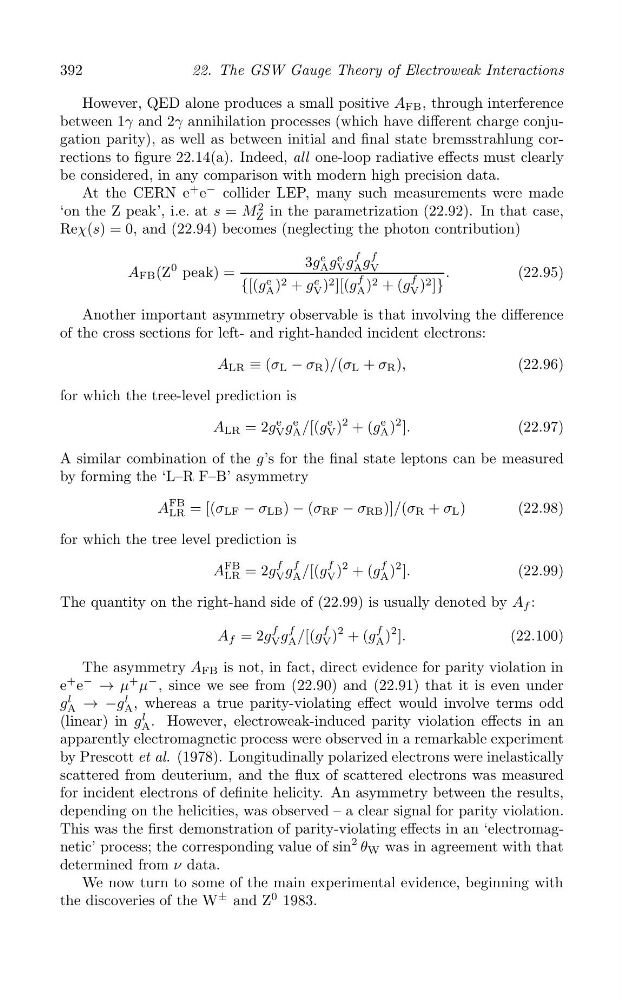
Reχ(s) = 0, and (22.94) becomes (neglecting the photon contribution)
f g
A
f
e e
A FB (Z
0 peak) =
3g A g V g V
.
(22.95)
f
A
f
V ) 2 ]}
) 2 + g ) 2 ][(g ) 2 + (g
e
{[(g A
e
V
Another important asymmetry observable is that involving the difference
of the cross sections for left- and right-handed incident electrons:
A LR ≡ (σ L − σ R )/(σ L + σ R ),
(22.96)
for which the tree-level prediction is
e e
e
e
A LR = 2g V g A /[(g V )
2 + (g A )
2 ].
(22.97)
A similar combination of the g’s for the final state leptons can be measured
by forming the ‘L–R F–B’ asymmetry
A
FB
LR = [(σ LF − σ LB ) − (σ RF − σ RB )]/(σ R + σ L )
(22.98)
for which the tree level prediction is
A
FB
LR = 2g
f
f
V g A /[(g
f
V )
2 + (g
f
A )
2 ].
(22.99)
The quantity on the right-hand side of (22.99) is usually denoted by A f :
A f = 2g
f
f
V g A /[(g
f
V )
2 + (g
f
A )
2 ].
(22.100)
The asymmetry A FB is not, in fact, direct evidence for parity violation in
+ −
e e → μ
+ μ
− , since we see from (22.90) and (22.91) that it is even under
l
→ −g
l
A , whereas a true parity-violating effect would involve terms odd
g A
l
A . However, electroweak-induced parity violation effects in an
(linear) in g
apparently electromagnetic process were observed in a remarkable experiment
by Prescott et al. (1978). Longitudinally polarized electrons were inelastically
scattered from deuterium, and the flux of scattered electrons was measured
for incident electrons of definite helicity. An asymmetry between the results,
depending on the helicities, was observed – a clear signal for parity violation.
This was the first demonstration of parity-violating effects in an ‘electromagnetic’ process; the corresponding value of sin
2 θ W was in agreement with that
determined from ν data.
We now turn to some of the main experimental evidence, beginning with
the discoveries of the W
± and Z
0 1983.