

22.3. Simple (tree-level) predictions
387
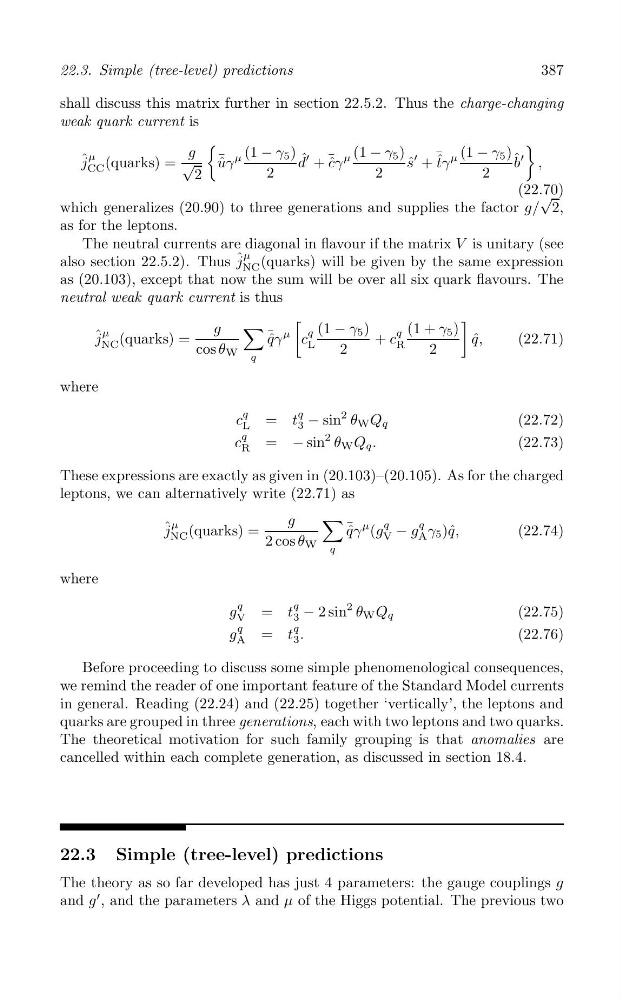
shall discuss this matrix further in section 22.5.2. Thus the charge-changing
weak quark current is
(
)
ˆ μ
g
(1 γ )
(1 γ )
ˆ ¯
5
(1
)
¯
5
¯
γ 5 ˆ
j CC (quarks) =
uγ ˆ
μ
−
d
′ + cγ
μ
−
s ˆ
′ + tγ ˆ μ −
√
ˆ
b
′ ,
2
2
2
2
(22.70)
which generalizes (20.90) to three generations and supplies the factor g/
√
2,
as for the leptons.
The neutral currents are diagonal in flavour if the matrix V is unitary (see
also section 22.5.2). Thus ˆ μ
j NC (quarks) will be given by the same expression
as (20.103), except that now the sum will be over all six quark flavours. The
neutral weak quark current is thus
[
]
ˆ μ
g ∑
q (1 γ )
q (1 + γ 5 )
¯
5
j NC (quarks) =
qγ ˆ
μ c L
−
+ c
cos θ
2
R
q, ˆ
(22.71)
W
2
q
where
q
q
c L = t 3 − sin
2 θ W Q q
(22.72)
q
c R = − sin
2 θ W Q q .
(22.73)
These expressions are exactly as given in (20.103)–(20.105). As for the charged
leptons, we can alternatively write (22.71) as
ˆ μ
g
∑ ¯
q
q
j NC (quarks) =
qγ ˆ
μ (g V − g A γ 5 )ˆ q,
(22.74)
2 cos θ W q
where
q
q
g V = t 3
q
− 2 sin
2 θ W Q q
(22.75)
q
g A = t 3 .
(22.76)
Before proceeding to discuss some simple phenomenological consequences,
we remind the reader of one important feature of the Standard Model currents
in general. Reading (22.24) and (22.25) together ‘vertically’, the leptons and
quarks are grouped in three generations, each with two leptons and two quarks.
The theoretical motivation for such family grouping is that anomalies are
cancelled within each complete generation, as discussed in section 18.4.
22.3 Simple (tree-level) predictions
The theory as so far developed has just 4 parameters: the gauge couplings g
and g
′ , and the parameters λ and μ of the Higgs potential. The previous two