

386
22. The GSW Gauge Theory of Electroweak Interactions
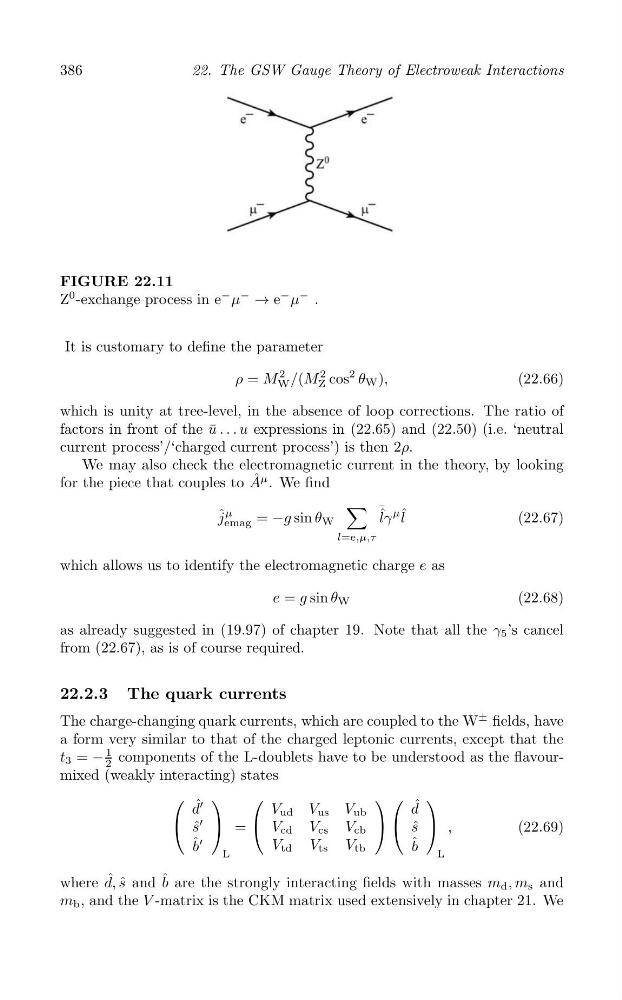
FIGURE 22.11
Z
0 -exchange process in e
− μ
−
→ e
− μ
− .
It is customary to define the parameter
ρ = M
2
W /(M
2
Z cos
2 θ W ),
(22.66)
which is unity at tree-level, in the absence of loop corrections. The ratio of
factors in front of the u ¯ . . . u expressions in (22.65) and (22.50) (i.e. ‘neutral
current process’/‘charged current process’) is then 2ρ.
We may also check the electromagnetic current in the theory, by looking
ˆ
for the piece that couples to A
μ . We find
∑
ˆ j
μ
¯
emag = −
ˆ ˆ
g sin θ W
lγ
μ l
(22.67)
l=e,μ,τ
which allows us to identify the electromagnetic charge e as
e = g sin θ W
(22.68)
as already suggested in (19.97) of chapter 19. Note that all the γ 5 ’s cancel
from (22.67), as is of course required.
22.2.3 The quark currents
The charge-changing quark currents, which are coupled to the W
± fields, have
a form very similar to that of the charged leptonic currents, except that the
t = −
1
3
components of the L-doublets have to be understood as the flavour2
mixed (weakly interacting) states
(
)
(
) (
)
ˆ
d
′
ˆ
V ud V us V ub
d
( s ˆ
′ ) = ( V cd V cs V cb ) ( s ˆ ) ,
(22.69)
ˆ b
′
V td V ts V tb
ˆ b
L
L
ˆ
ˆ
where d, s ˆ and b are the strongly interacting fields with masses m d , m s and
m b , and the V -matrix is the CKM matrix used extensively in chapter 21. We