

388
22. The GSW Gauge Theory of Electroweak Interactions
subsections show that all the couplings to fermions can be written in terms
of the known quantities G F and e (or α), and one free parameter which may
be taken to be sin θ W . We noted in section 20.9 that, before the discovery of
the W and Z particles, the then known neutrino data were consistent with a
single value of θ W given by sin
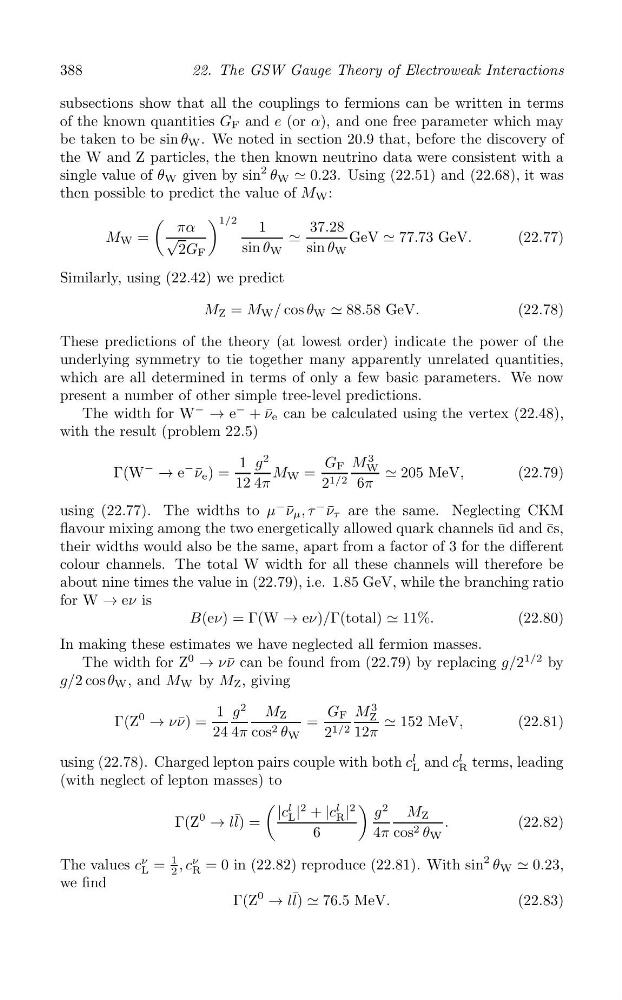
2 θ W ⋍ 0.23. Using (22.51) and (22.68), it was
then possible to predict the value of M W :
(
) 1/2
πα
1
37.28
M W = √
⋍
GeV ⋍ 77.73 GeV.
(22.77)
2G F
sin θ W
sin θ W
Similarly, using (22.42) we predict
M Z = M W / cos θ W ⋍ 88.58 GeV.
(22.78)
These predictions of the theory (at lowest order) indicate the power of the
underlying symmetry to tie together many apparently unrelated quantities,
which are all determined in terms of only a few basic parameters. We now
present a number of other simple tree-level predictions.
The width for W
−
→ e
− + ¯
ν e can be calculated using the vertex (22.48),
with the result (problem 22.5)
1 g
2
G M
3
Γ(W
−
→ e
−
F
ν ¯ e ) =
M W =
W
205 MeV,
(22.79)
12 4π
2 1/2 6π
⋍
using (22.77). The widths to μ
− ν ¯ μ , τ
− ν ¯ τ are the same. Neglecting CKM
flavour mixing among the two energetically allowed quark channels ud ¯ and ¯ cs,
their widths would also be the same, apart from a factor of 3 for the different
colour channels. The total W width for all these channels will therefore be
about nine times the value in (22.79), i.e. 1.85 GeV, while the branching ratio
for W → eν is
B(eν) = Γ(W → eν)/Γ(total) ⋍ 11%.
(22.80)
In making these estimates we have neglected all fermion masses.
The width for Z
0
→ νν ¯ can be found from (22.79) by replacing g/2
1/2 by
g/2 cos θ W , and M W by M Z , giving
0
1 g
2
M
G M
3
Z
Γ(Z →
F
νν ¯) =
=
Z
152 MeV,
(22.81)
24 4π cos 2 θ
/2
W
2 1 12π
⋍
using (22.78). Charged lepton pairs couple with both c
l
L and c
l
R terms, leading
(with neglect of lepton masses) to
(
)
Γ(Z
0
¯
ll) =
|c
l
|
2 + |c
l
|
2
g
2
M
→
L
R
Z
.
(22.82)
6
4π cos 2 θ W
The values c
ν
1 ν
2
L = , c R = 0 in (22.82) reproduce (22.81). With sin θ W
2
⋍ 0.23,
we find
Γ(Z
0
→ ¯
ll) ⋍ 76.5 MeV.
(22.83)