

376
22. The GSW Gauge Theory of Electroweak Interactions
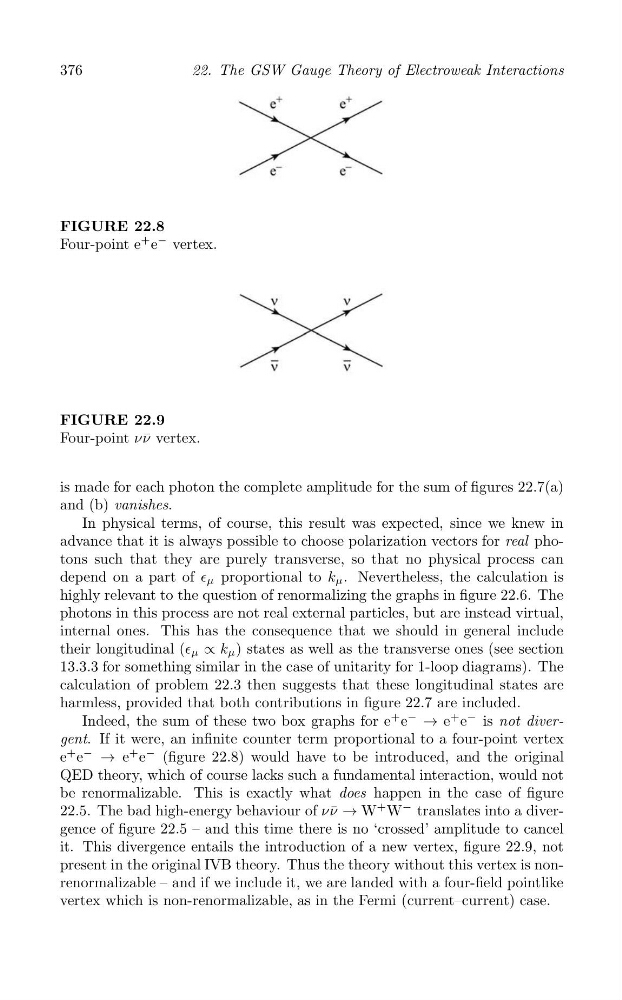
FIGURE 22.8
−
Four-point e
+ e vertex.
FIGURE 22.9
Four-point νν ¯ vertex.
is made for each photon the complete amplitude for the sum of figures 22.7(a)
and (b) vanishes.
In physical terms, of course, this result was expected, since we knew in
advance that it is always possible to choose polarization vectors for real photons such that they are purely transverse, so that no physical process can
depend on a part of ∈ μ proportional to k μ . Nevertheless, the calculation is
highly relevant to the question of renormalizing the graphs in figure 22.6. The
photons in this process are not real external particles, but are instead virtual,
internal ones. This has the consequence that we should in general include
their longitudinal (∈ μ ∝ k μ ) states as well as the transverse ones (see section
13.3.3 for something similar in the case of unitarity for 1-loop diagrams). The
calculation of problem 22.3 then suggests that these longitudinal states are
harmless, provided that both contributions in figure 22.7 are included.
−
+ −
Indeed, the sum of these two box graphs for e
+ e → e e is not divergent. If it were, an infinite counter term proportional to a four-point vertex
+ −
+ −
e e → e e (figure 22.8) would have to be introduced, and the original
QED theory, which of course lacks such a fundamental interaction, would not
be renormalizable. This is exactly what does happen in the case of figure
22.5. The bad high-energy behaviour of νν ¯ → W
+ W
− translates into a divergence of figure 22.5 – and this time there is no ‘crossed’ amplitude to cancel
it. This divergence entails the introduction of a new vertex, figure 22.9, not
present in the original IVB theory. Thus the theory without this vertex is nonrenormalizable – and if we include it, we are landed with a four-field pointlike
vertex which is non-renormalizable, as in the Fermi (current–current) case.