

377
22.2. The SU(2) × U(1) electroweak gauge theory
Our presentation hitherto has emphasized the fact that, in QED, the bad
high-energy behaviour is rendered harmless by a cancellation between contributions from figures 22.7(a) and (b) (or figures 22.6(a) and (b)). Thus one
way to ‘fix up’ the IVB theory might be to hypothesize a new physical process,
to be added to figure 22.4, in such a way that a cancellation occurred at high
energies. The search for such high-energy cancellation mechanisms can indeed
be pushed to a successful conclusion (Llewellyn Smith 1973), given sufficient
ingenuity and, arguably, a little hindsight. However, we are in possession of
a more powerful principle. In QED, we have already seen (section 8.6.2) that
the vanishing of amplitudes when an ∈ μ is replaced by the corresponding k μ is
due to gauge invariance: in other words, the potentially harmful longitudinal
polarization states are in fact harmless in a gauge-invariant theory.
We have therefore arrived once more, after a somewhat more leisurely
discussion than that of section 19.1, at the idea that we need a gauge theory
of massive vector bosons, so that the offending k
μ k
ν part of the propagator can
be ‘gauged away’ as in the photon case. This is precisely what is provided by
the ‘spontaneously broken’ gauge theory concept, as developed in chapter 19.
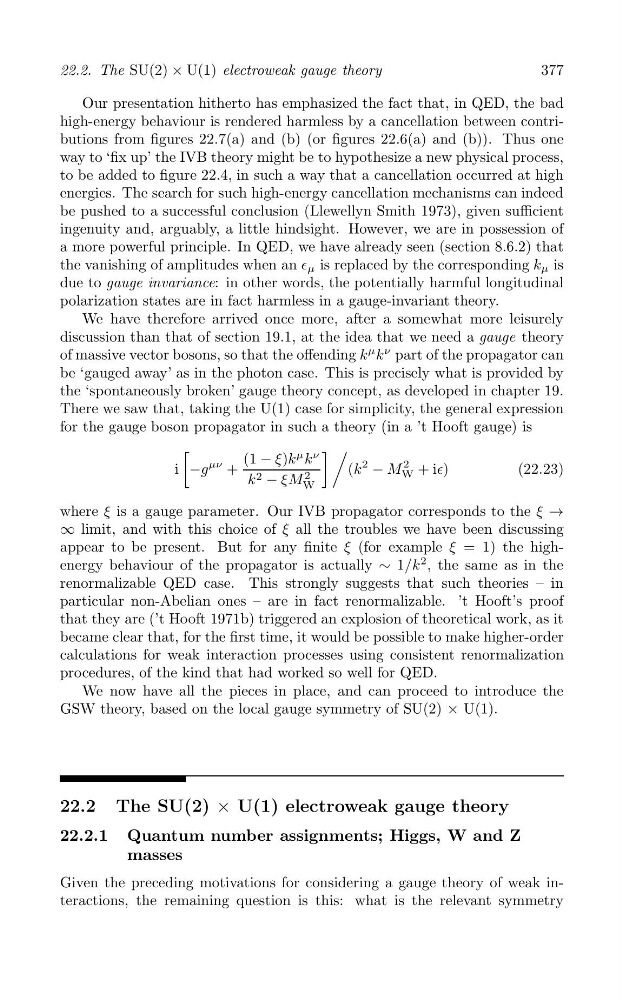
There we saw that, taking the U(1) case for simplicity, the general expression
for the gauge boson propagator in such a theory (in a ’t Hooft gauge) is
[
] √
(1 − ξ)k
μ k
ν
μν
i −g +
(k
2
− M
2
(22.23)
W + i∈)
k 2 − ξM 2
W
where ξ is a gauge parameter. Our IVB propagator corresponds to the ξ →
∞ limit, and with this choice of ξ all the troubles we have been discussing
appear to be present. But for any finite ξ (for example ξ = 1) the highenergy behaviour of the propagator is actually ∼ 1/k
2 , the same as in the
renormalizable QED case. This strongly suggests that such theories – in
particular non-Abelian ones – are in fact renormalizable. ’t Hooft’s proof
that they are (’t Hooft 1971b) triggered an explosion of theoretical work, as it
became clear that, for the first time, it would be possible to make higher-order
calculations for weak interaction processes using consistent renormalization
procedures, of the kind that had worked so well for QED.
We now have all the pieces in place, and can proceed to introduce the
GSW theory, based on the local gauge symmetry of SU(2) × U(1).
22.2 The SU(2) × U(1) electroweak gauge theory
22.2.1 Quantum number assignments; Higgs, W and Z
masses
Given the preceding motivations for considering a gauge theory of weak interactions, the remaining question is this: what is the relevant symmetry