

375
22.1. Difficulties with the current–current and ‘naive’ IVB models
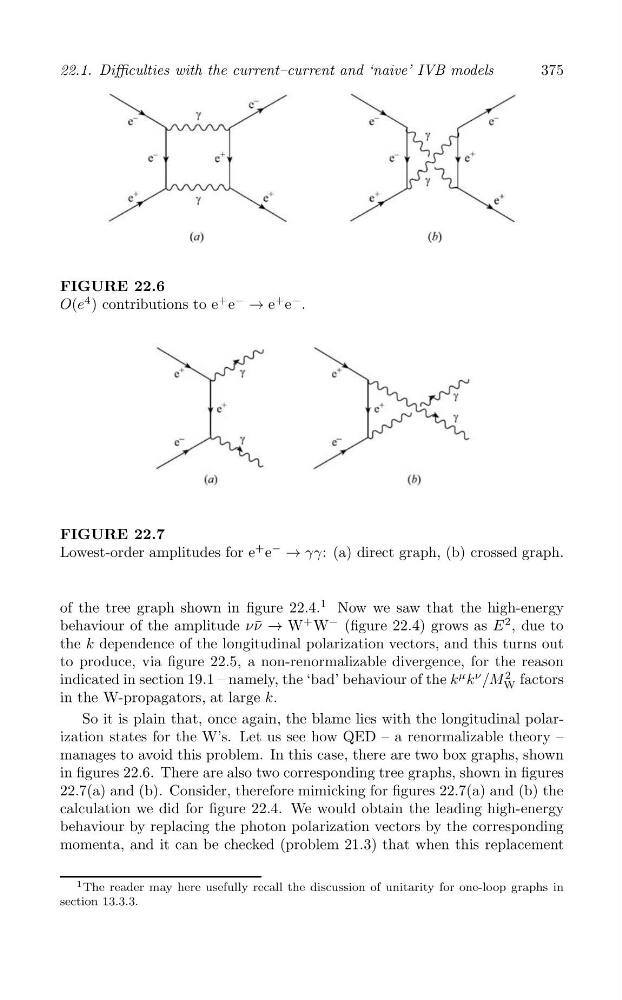
FIGURE 22.6
+ −
O(e
4 ) contributions to e
+ e
−
→ e e .
FIGURE 22.7
Lowest-order amplitudes for e
+ e
−
→ γγ: (a) direct graph, (b) crossed graph.
of the tree graph shown in figure 22.4.
1 Now we saw that the high-energy
behaviour of the amplitude νν ¯ → W
+ W
− (figure 22.4) grows as E
2 , due to
the k dependence of the longitudinal polarization vectors, and this turns out
to produce, via figure 22.5, a non-renormalizable divergence, for the reason
indicated in section 19.1 – namely, the ‘bad’ behaviour of the k
μ k
ν /M
2 factors
W
in the W-propagators, at large k.
So it is plain that, once again, the blame lies with the longitudinal polarization states for the W’s. Let us see how QED – a renormalizable theory –
manages to avoid this problem. In this case, there are two box graphs, shown
in figures 22.6. There are also two corresponding tree graphs, shown in figures
22.7(a) and (b). Consider, therefore mimicking for figures 22.7(a) and (b) the
calculation we did for figure 22.4. We would obtain the leading high-energy
behaviour by replacing the photon polarization vectors by the corresponding
momenta, and it can be checked (problem 21.3) that when this replacement
1 The reader may here usefully recall the discussion of unitarity for one-loop graphs in
section 13.3.3.