

374
22. The GSW Gauge Theory of Electroweak Interactions
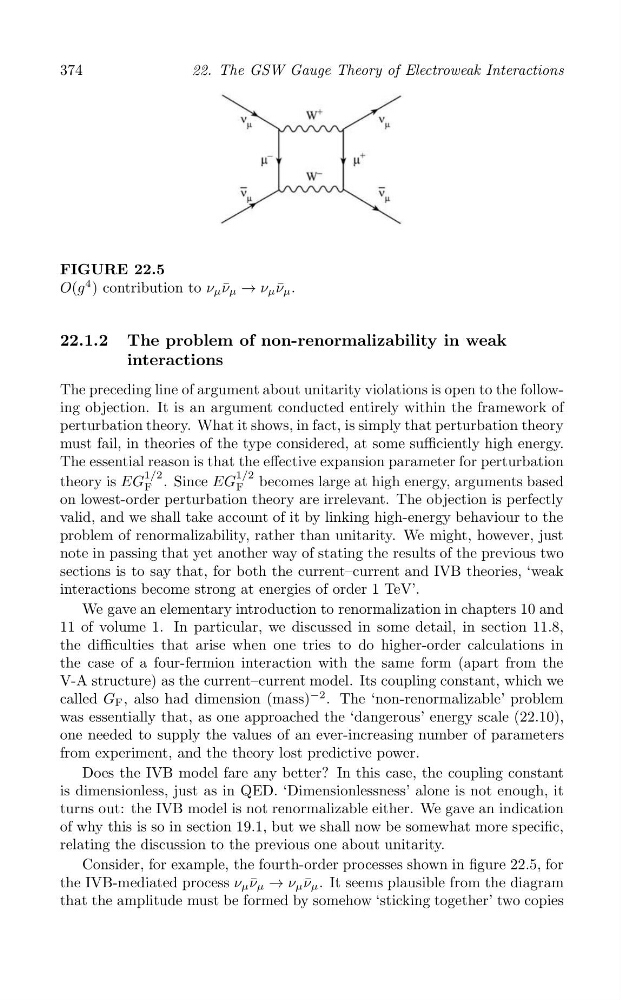
FIGURE 22.5
O(g
4 ) contribution to ν μ ν ¯ μ → ν μ ν ¯ μ .
22.1.2 The problem of non-renormalizability in weak
interactions
The preceding line of argument about unitarity violations is open to the following objection. It is an argument conducted entirely within the framework of
perturbation theory. What it shows, in fact, is simply that perturbation theory
must fail, in theories of the type considered, at some sufficiently high energy.
The essential reason is that the effective expansion parameter for perturbation
1/2
1/2
theory is EG . Since EG
becomes large at high energy, arguments based
F
F
on lowest-order perturbation theory are irrelevant. The objection is perfectly
valid, and we shall take account of it by linking high-energy behaviour to the
problem of renormalizability, rather than unitarity. We might, however, just
note in passing that yet another way of stating the results of the previous two
sections is to say that, for both the current–current and IVB theories, ‘weak
interactions become strong at energies of order 1 TeV’.
We gave an elementary introduction to renormalization in chapters 10 and
11 of volume 1. In particular, we discussed in some detail, in section 11.8,
the difficulties that arise when one tries to do higher-order calculations in
the case of a four-fermion interaction with the same form (apart from the
V-A structure) as the current–current model. Its coupling constant, which we
called G F , also had dimension (mass)
−2 . The ‘non-renormalizable’ problem
was essentially that, as one approached the ‘dangerous’ energy scale (22.10),
one needed to supply the values of an ever-increasing number of parameters
from experiment, and the theory lost predictive power.
Does the IVB model fare any better? In this case, the coupling constant
is dimensionless, just as in QED. ‘Dimensionlessness’ alone is not enough, it
turns out: the IVB model is not renormalizable either. We gave an indication
of why this is so in section 19.1, but we shall now be somewhat more specific,
relating the discussion to the previous one about unitarity.
Consider, for example, the fourth-order processes shown in figure 22.5, for
the IVB-mediated process ν μ ν ¯ μ → ν μ ν ¯ μ . It seems plausible from the diagram
that the amplitude must be formed by somehow ‘sticking together’ two copies