

371
22.1. Difficulties with the current–current and ‘naive’ IVB models
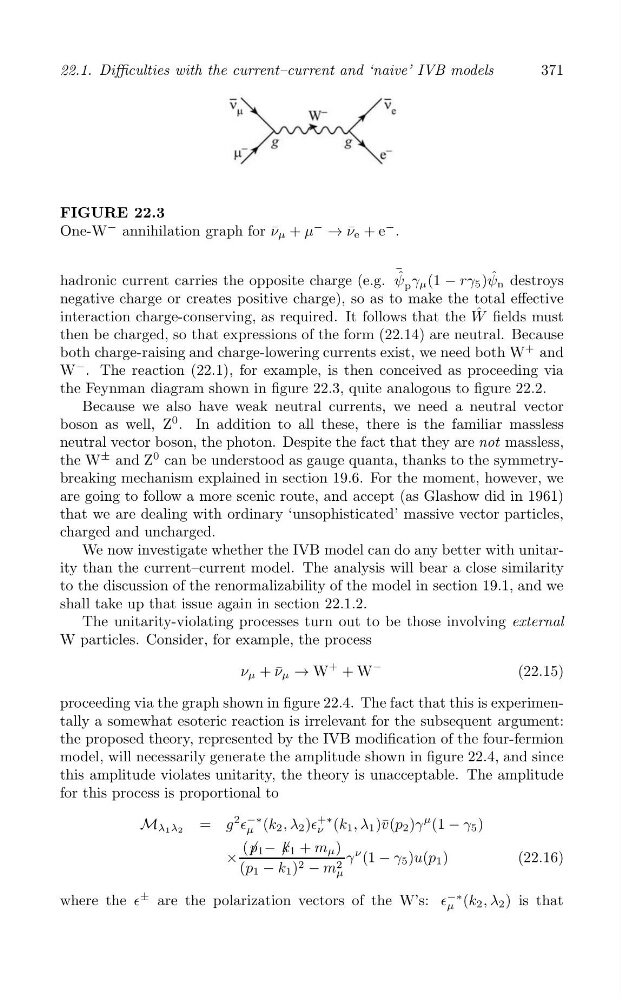
FIGURE 22.3
One-W
− annihilation graph for ¯
ν μ + μ
−
→ ν ¯ e + e
− .
¯
hadronic current carries the opposite charge (e.g. ψ ˆ
p γ μ (1 − rγ 5 )ψ ˆ n destroys
negative charge or creates positive charge), so as to make the total effective
interaction charge-conserving, as required. It follows that the W ˆ fields must
then be charged, so that expressions of the form (22.14) are neutral. Because
both charge-raising and charge-lowering currents exist, we need both W
+ and
W
− . The reaction (22.1), for example, is then conceived as proceeding via
the Feynman diagram shown in figure 22.3, quite analogous to figure 22.2.
Because we also have weak neutral currents, we need a neutral vector
boson as well, Z
0 . In addition to all these, there is the familiar massless
neutral vector boson, the photon. Despite the fact that they are not massless,
the W
± and Z
0 can be understood as gauge quanta, thanks to the symmetrybreaking mechanism explained in section 19.6. For the moment, however, we
are going to follow a more scenic route, and accept (as Glashow did in 1961)
that we are dealing with ordinary ‘unsophisticated’ massive vector particles,
charged and uncharged.
We now investigate whether the IVB model can do any better with unitarity than the current–current model. The analysis will bear a close similarity
to the discussion of the renormalizability of the model in section 19.1, and we
shall take up that issue again in section 22.1.2.
The unitarity-violating processes turn out to be those involving external
W particles. Consider, for example, the process
ν μ + ¯
ν μ → W
+ + W
−
(22.15)
proceeding via the graph shown in figure 22.4. The fact that this is experimentally a somewhat esoteric reaction is irrelevant for the subsequent argument:
the proposed theory, represented by the IVB modification of the four-fermion
model, will necessarily generate the amplitude shown in figure 22.4, and since
this amplitude violates unitarity, the theory is unacceptable. The amplitude
for this process is proportional to
2 ∈
−∗
M λ1λ2 = g
(k 2 , λ 2 )∈
+∗ (k 1 , λ 1 )¯ v(p 2 )γ
μ (1 − γ 5 )
μ
ν
(/ p 1 − / k 1 + m μ )
×
γ
ν (1 − γ 5 )u(p 1 )
(22.16)
(p 1 − k 1 ) 2 − m 2
μ
where the ∈
± are the polarization vectors of the W’s: ∈
−∗ (k 2 , λ 2 ) is that
μ