

372
22. The GSW Gauge Theory of Electroweak Interactions
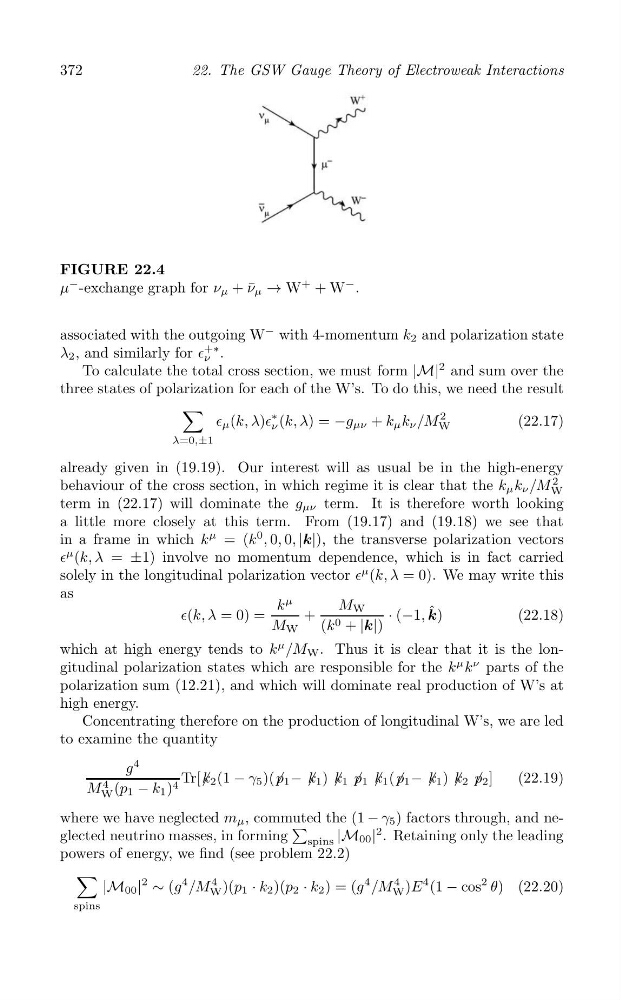
FIGURE 22.4
μ
− -exchange graph for ν μ + ¯
ν μ → W
+ + W
− .
associated with the outgoing W
− with 4-momentum k 2 and polarization state
λ , and similarly for ∈
+
2
ν
∗ .
To calculate the total cross section, we must form |M|
2 and sum over the
three states of polarization for each of the W’s. To do this, we need the result
∑
∈ (k, λ)∈
∗ (k, λ) = −g + k k /M
2
μ
ν
μν
μ ν
W
(22.17)
λ=0,±1
already given in (19.19). Our interest will as usual be in the high-energy
behaviour of the cross section, in which regime it is clear that the k μ k ν /M
2
W
term in (22.17) will dominate the g μν term. It is therefore worth looking
a little more closely at this term. From (19.17) and (19.18) we see that
in a frame in which k
μ = (k
0 , 0, 0, |k|), the transverse polarization vectors
∈
μ (k, λ = ±1) involve no momentum dependence, which is in fact carried
solely in the longitudinal polarization vector ∈
μ (k, λ = 0). We may write this
as
k
μ
M W
ˆ
∈(k, λ = 0) =
+
· (−1, k)
(22.18)
M W
(k 0 + |k|)
which at high energy tends to k
μ /M W . Thus it is clear that it is the longitudinal polarization states which are responsible for the k
μ k
ν parts of the
polarization sum (12.21), and which will dominate real production of W’s at
high energy.
Concentrating therefore on the production of longitudinal W’s, we are led
to examine the quantity
g
4
Tr[ k 2 (1 − γ 5 )( p 1 − k 1 ) k 1 p 1 k (
M 4
W (p 1 −
1 p 1
k ) 4
1
− k 1 ) k 2 p 2 ]
(22.19)
where we have neglected m μ , comm uted the (1 − γ 5 ) factors through, and neglected neutrino masses, in forming spins |M 00 |
2 . Retaining only the leading
powers of energy, we find (see problem 22.2)
∑ |M
2
4
4
2
00 | ∼ (g
4 /M
4
4
W )(p 1 · k 2 )(p 2 · k 2 ) = (g /M W )E (1
ins
− cos θ) (22.20)
sp
/
/
/
/ / / /
/
/ /