

370
22. The GSW Gauge Theory of Electroweak Interactions
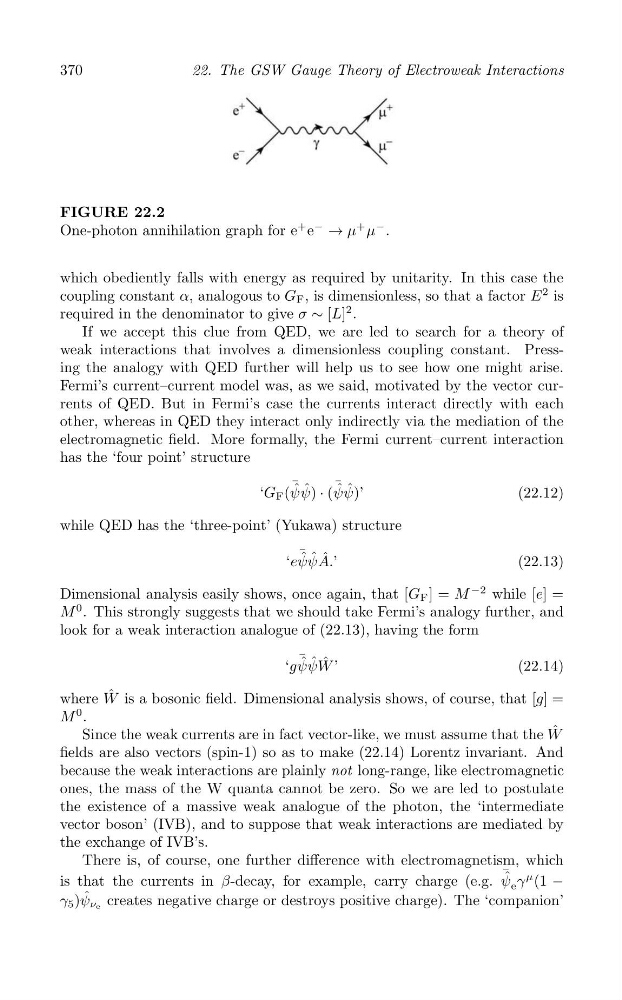
FIGURE 22.2
One-photon annihilation graph for e
+ e
−
→ μ
+ μ
− .
which obediently falls with energy as required by unitarity. In this case the
coupling constant α, analogous to G F , is dimensionless, so that a factor E
2 is
required in the denominator to give σ ∼ [L]
2 .
If we accept this clue from QED, we are led to search for a theory of
weak interactions that involves a dimensionless coupling constant. Pressing the analogy with QED further will help us to see how one might arise.
Fermi’s current–current model was, as we said, motivated by the vector currents of QED. But in Fermi’s case the currents interact directly with each
other, whereas in QED they interact only indirectly via the mediation of the
electromagnetic field. More formally, the Fermi current–current interaction
has the ‘four point’ structure
¯
¯
‘G F (ψ ˆ ψ ˆ ) · (ψ ˆ ψ ˆ )’
(22.12)
while QED has the ‘three-point’ (Yukawa) structure
¯
‘eψ ˆ A.’
ˆ ψ ˆ
(22.13)
Dimensional analysis easily shows, once again, that [G F ] = M
−2 while [e] =
M
0 . This strongly suggests that we should take Fermi’s analogy further, and
look for a weak interaction analogue of (22.13), having the form
¯ ˆ
‘gψψ ˆ W ˆ ’
(22.14)
where W ˆ is a bosonic field. Dimensional analysis shows, of course, that [g] =
M
0 .
Since the weak currents are in fact vector-like, we must assume that the W ˆ
fields are also vectors (spin-1) so as to make (22.14) Lorentz invariant. And
because the weak interactions are plainly not long-range, like electromagnetic
ones, the mass of the W quanta cannot be zero. So we are led to postulate
the existence of a massive weak analogue of the photon, the ‘intermediate
vector boson’ (IVB), and to suppose that weak interactions are mediated by
the exchange of IVB’s.
There is, of course, one further difference with electromagnetism, which
¯
is that the currents in β-decay, for example, carry charge (e.g. ψ ˆ γ
μ (1 −
e
γ 5 )ψ ˆ νe creates negative charge or destroys positive charge). The ‘companion’