

67
3.2. The Dirac equation
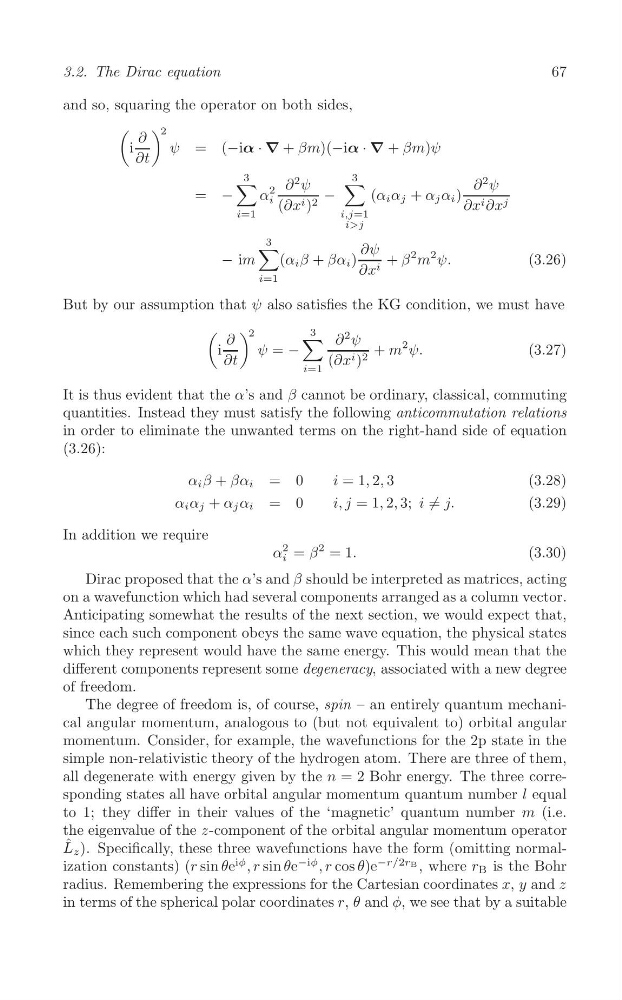
and so, squaring the operator on both sides,
( ) 2
∂
i
ψ = (−iα · ∇ + βm)(−iα · ∇ + βm)ψ
∂t
3
3
∑
∂
2 ψ
∑
∂
2 ψ
= −
−
(α i α j + α j α i )
α
2
i (∂x i ) 2
∂x i ∂x j
i=1
i,j=1
i>j
3
∑
− im
(α i β + βα i )
∂ψ + β
2 m
2 ψ.
(3.26)
∂x i
i=1
But by our assumption that ψ also satisfies the KG condition, we must have
( ) 2
3
∑
∂
∂
2 ψ
i
ψ = −
+ m
2 ψ.
(3.27)
∂t
(∂x i ) 2
i=1
It is thus evident that the α’s and β cannot be ordinary, classical, commuting
quantities. Instead they must satisfy the following anticommutation relations
in order to eliminate the unwanted terms on the right-hand side of equation
(3.26):
α i β + βα i = 0
i = 1, 2, 3
(3.28)
α i α j + α j α i = 0
/ j.
(3.29)
i, j = 1, 2, 3; i =
In addition we require
α
2 = β
2 = 1.
(3.30)
i
Dirac proposed that the α’s and β should be interpreted as matrices, acting
on a wavefunction which had several components arranged as a column vector.
Anticipating somewhat the results of the next section, we would expect that,
since each such component obeys the same wave equation, the physical states
which they represent would have the same energy. This would mean that the
different components represent some degeneracy, associated with a new degree
of freedom.
The degree of freedom is, of course, spin – an entirely quantum mechanical angular momentum, analogous to (but not equivalent to) orbital angular
momentum. Consider, for example, the wavefunctions for the 2p state in the
simple non-relativistic theory of the hydrogen atom. There are three of them,
all degenerate with energy given by the n = 2 Bohr energy. The three corresponding states all have orbital angular momentum quantum number l equal
to 1; they differ in their values of the ‘magnetic’ quantum number m (i.e.
the eigenvalue of the z-component of the orbital angular momentum operator
ˆ
L z ). Specifically, these three wavefunctions have the form (omitting normaliφ
−iφ
ization constants) (r sin θe , r sin θe , r cos θ)e
−r/2rB , where r B is the Bohr
radius. Remembering the expressions for the Cartesian coordinates x, y and z
in terms of the spherical polar coordinates r, θ and φ, we see that by a suitable
3.2. The Dirac equation
and so, squaring the operator on both sides,
( ) 2
∂
i
ψ = (−iα · ∇ + βm)(−iα · ∇ + βm)ψ
∂t
3
3
∑
∂
2 ψ
∑
∂
2 ψ
= −
−
(α i α j + α j α i )
α
2
i (∂x i ) 2
∂x i ∂x j
i=1
i,j=1
i>j
3
∑
− im
(α i β + βα i )
∂ψ + β
2 m
2 ψ.
(3.26)
∂x i
i=1
But by our assumption that ψ also satisfies the KG condition, we must have
( ) 2
3
∑
∂
∂
2 ψ
i
ψ = −
+ m
2 ψ.
(3.27)
∂t
(∂x i ) 2
i=1
It is thus evident that the α’s and β cannot be ordinary, classical, commuting
quantities. Instead they must satisfy the following anticommutation relations
in order to eliminate the unwanted terms on the right-hand side of equation
(3.26):
α i β + βα i = 0
i = 1, 2, 3
(3.28)
α i α j + α j α i = 0
/ j.
(3.29)
i, j = 1, 2, 3; i =
In addition we require
α
2 = β
2 = 1.
(3.30)
i
Dirac proposed that the α’s and β should be interpreted as matrices, acting
on a wavefunction which had several components arranged as a column vector.
Anticipating somewhat the results of the next section, we would expect that,
since each such component obeys the same wave equation, the physical states
which they represent would have the same energy. This would mean that the
different components represent some degeneracy, associated with a new degree
of freedom.
The degree of freedom is, of course, spin – an entirely quantum mechanical angular momentum, analogous to (but not equivalent to) orbital angular
momentum. Consider, for example, the wavefunctions for the 2p state in the
simple non-relativistic theory of the hydrogen atom. There are three of them,
all degenerate with energy given by the n = 2 Bohr energy. The three corresponding states all have orbital angular momentum quantum number l equal
to 1; they differ in their values of the ‘magnetic’ quantum number m (i.e.
the eigenvalue of the z-component of the orbital angular momentum operator
ˆ
L z ). Specifically, these three wavefunctions have the form (omitting normaliφ
−iφ
ization constants) (r sin θe , r sin θe , r cos θ)e
−r/2rB , where r B is the Bohr
radius. Remembering the expressions for the Cartesian coordinates x, y and z
in terms of the spherical polar coordinates r, θ and φ, we see that by a suitable