

21.3. CP violation in neutral K-meson decays
347
¯
K
0
B
0
¯
d
¯ s
s
f
d
¯
K
0
¯
d
s
f
¯ s
K
0
d
¯ f
¯ f
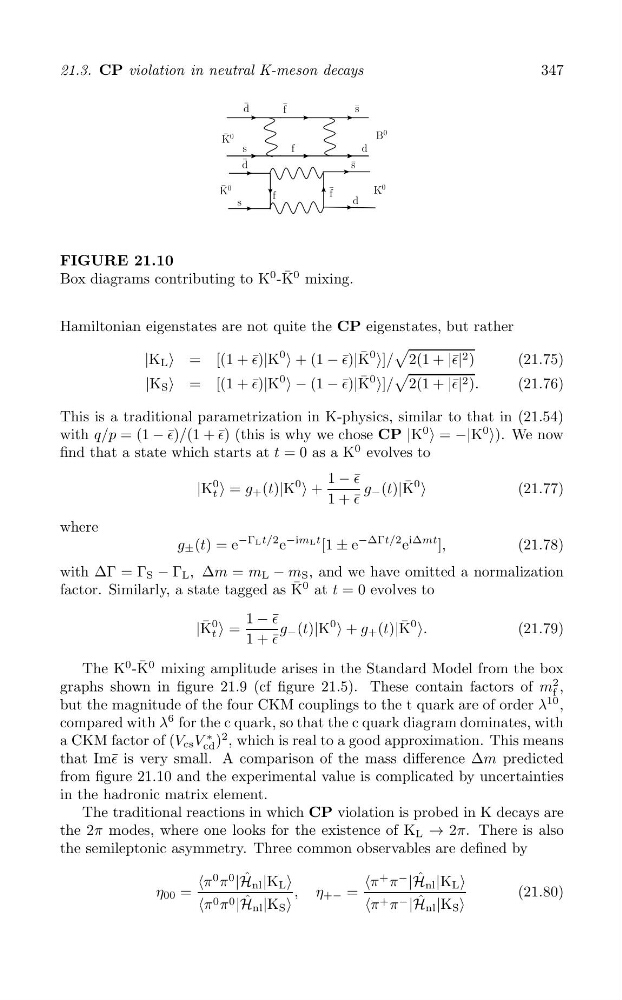
FIGURE 21.10
Box diagrams contributing to K
0 - ¯
K
0 mixing.
Hamiltonian eigenstates are not quite the CP eigenstates, but rather
√
|K L › = [(1 + ∈ ¯)|K
0
› + (1 − ∈ ¯)| ¯
K
0
›]/ 2(1 + |∈ ¯| 2 )
(21.75)
√
|K S ›
¯
= [(1 + ∈ ¯)|K
0
› − (1 − ∈ ¯)|K
0
›]/ 2(1 + |∈ ¯| 2 ).
(21.76)
This is a traditional parametrization in K-physics, similar to that in (21.54)
with q/p = (1 − ∈ ¯)/(1 + ∈ ¯) (this is why we chose CP |K
0
› = −|K
0
›). We now
find that a state which starts at t = 0 as a K
0 evolves to
|K
0
t › = g + (t)|K
0
1
› +
− ¯ ∈ g (t)| ¯
K
0
1 + ¯
∈
−
›
(21.77)
where
g (t) = e
−ΓLt/2 e
−imLt [1 ± e
−ΔΓt/2 e
iΔmt ],
(21.78)
±
with ΔΓ = Γ S − Γ L , Δm = m L − m S , and we have omitted a normalization
¯
factor. Similarly, a state tagged as K
0 at t = 0 evolves to
| ¯
K
0
1
t › =
− ∈ ¯ g (t)|K
0
›
¯
+ g + (t)
1 + ∈ ¯
−
|K
0
›.
(21.79)
The K
0 ¯
-K
0 mixing amplitude arises in the Standard Model from the box
graphs shown in figure 21.9 (cf figure 21.5). These contain factors of m
2
f ,
but the magnitude of the four CKM couplings to the t quark are of order λ
10 ,
compared with λ
6 for the c quark, so that the c quark diagram dominates, with
a CKM factor of (V
2
cs V cd
∗ ) , which is real to a good approximation. This means
that Im∈ ¯ is very small. A comparison of the mass difference Δm predicted
from figure 21.10 and the experimental value is complicated by uncertainties
in the hadronic matrix element.
The traditional reactions in which CP violation is probed in K decays are
the 2π modes, where one looks for the existence of K L → 2π. There is also
the semileptonic asymmetry. Three common observables are defined by
‹
0 0
|H ˆ
π
− ˆ
π π
K
π
+
nl
L
nl K L
η 00 =
| › , η
=
‹
|
‹ 0
ˆ
+
H | ›
(21.80)
π π 0 |H nl |K
−
+
ˆ
S ›
‹π π − |H nl |K S ›