

348
21. CP Violation and Oscillation Phenomena
and
−
+ − ¯
Γ(K L → π e
+ ν e ) − Γ(K L → π e ν e )
δ L =
.
(21.81)
Γ(K L → π − e + ν e ) + Γ(K L → π + e − ν ¯ e )
The experimental numbers are (Nakamura et al. 2010)
|η 00 | = (2.221 ± 0.011) × 10
−3 , |η +− | = (2.232 ± 0.011) × 10
−3
(21.82)
Arg η 00 ≈ 43.5
◦ , Arg η ± ≈ 43.5
◦
(21.83)
and
δ L = (3.32 ± 0.06) × 10
−3 .
(21.84)
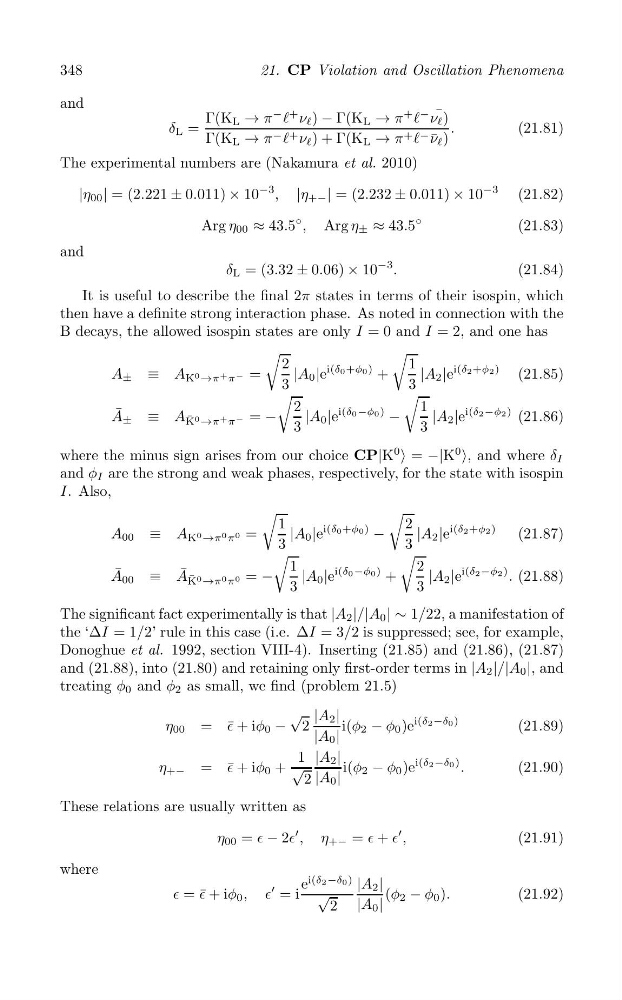
It is useful to describe the final 2π states in terms of their isospin, which
then have a definite strong interaction phase. As noted in connection with the
B decays, the allowed isospin states are only I = 0 and I = 2, and one has
/
/
2
1
i(δ0+φ0)
i(δ2+φ2)
A ± ≡ A
=
|A 0 |e
+
|A 2 |e
(21.85)
K 0 →π + π −
3
3
/
/
2
1
¯
i(δ0 −φ0)
−
≡
¯
=
|A 0 |e
|A 2 |e
i(δ2 −φ2) (21.86)
A ±
A K 0 →π + π − − 3
3
where the minus sign arises from our choice CP|K
0
› = −|K
0
›, and where δ I
and φ I are the strong and weak phases, respectively, for the state with isospin
I. Also,
/
/
1
2
i(δ0+φ0)
−
i(δ2+φ2)
A 00 ≡ A
=
|A 0 |e
|A 2 |e
(21.87)
K 0 →π 0 π 0
3
3
/
/
1
2
i(δ0 −φ0)
i(δ2 −φ2)
A ¯ 00 ≡ A ¯ ¯
= −
|A 0 |e
+
|A 2 |e
. (21.88)
K 0 →π 0 π 0
3
3
The significant fact experimentally is that |A 2 |/|A 0 | ∼ 1/22, a manifestation of
the ‘ΔI = 1/2’ rule in this case (i.e. ΔI = 3/2 is suppressed; see, for example,
Donoghue et al. 1992, section VIII-4). Inserting (21.85) and (21.86), (21.87)
and (21.88), into (21.80) and retaining only first-order terms in |A 2 |/|A 0 |, and
treating φ 0 and φ 2 as small, we find (problem 21.5)
√ |A 2 |
η 00 = ¯ ∈ + iφ 0 − 2
i(φ 2 − φ 0 )e
i(δ2−δ0)
(21.89)
|A 0 |
1 |A 2 |
η +− = ¯ ∈ + iφ 0 + √
i(φ 2 − φ 0 )e
i(δ2−δ0 ) .
(21.90)
2 |A 0 |
These relations are usually written as
′
η 00 = ∈ − 2∈
′ , η +− = ∈ + ∈ ,
(21.91)
where
i(δ2 −δ0)
e
|A 2 |
′
∈ = ¯
∈ + iφ 0 , ∈ = i √
(φ 2 − φ 0 ).
(21.92)
2 |A 0 |