

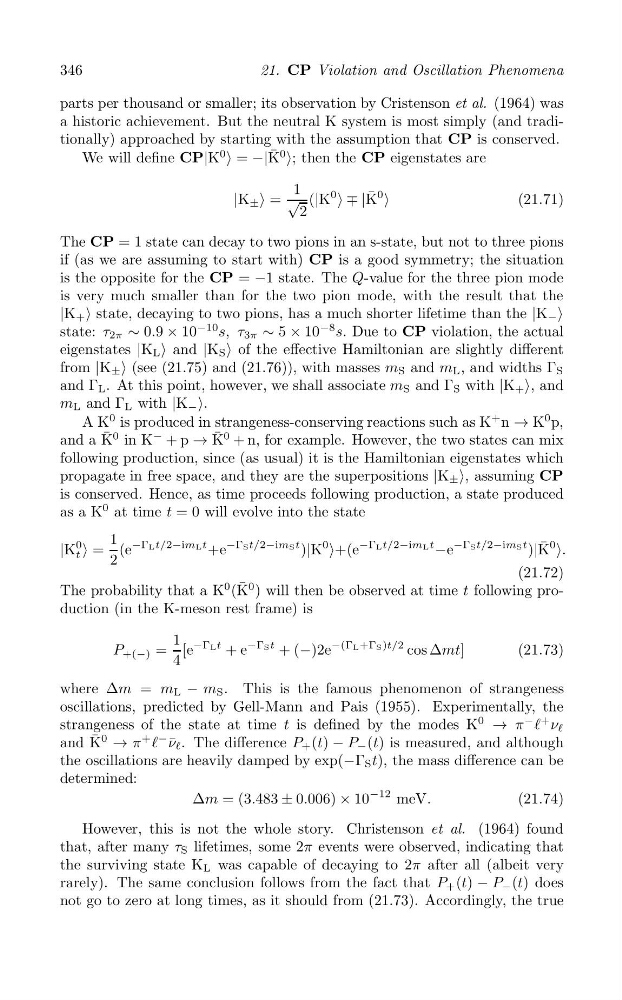
346
21. CP Violation and Oscillation Phenomena
parts per thousand or smaller; its observation by Cristenson et al. (1964) was
a historic achievement. But the neutral K system is most simply (and traditionally) approached by starting with the assumption that CP is conserved.
We will define CP|K
0
› = −|K ¯ 0 ›; then the CP eigenstates are
1
|K ± › = √ (|K
0
› ∓ |K ¯ 0 ›
(21.71)
2
The CP = 1 state can decay to two pions in an s-state, but not to three pions
if (as we are assuming to start with) CP is a good symmetry; the situation
is the opposite for the CP = −1 state. The Q-value for the three pion mode
is very much smaller than for the two pion mode, with the result that the
|K + › state, decaying to two pions, has a much shorter lifetime than the |K − ›
state: τ 2π ∼ 0.9 × 10
−10 s, τ 3π ∼ 5 × 10
−8 s. Due to CP violation, the actual
eigenstates |K L › and |K S › of the effective Hamiltonian are slightly different
from |K ± › (see (21.75) and (21.76)), with masses m S and m L , and widths Γ S
and Γ L . At this point, however, we shall associate m S and Γ S with |K + ›, and
m L and Γ L with |K − ›.
A K
0 is produced in strangeness-conserving reactions such as K
+ n → K
0 p,
¯
and a K
0 in K
− + p → K ¯ 0 + n, for example. However, the two states can mix
following production, since (as usual) it is the Hamiltonian eigenstates which
propagate in free space, and they are the superpositions |K ± ›, assuming CP
is conserved. Hence, as time proceeds following production, a state produced
as a K
0 at time t = 0 will evolve into the state
1
|K
0
› = (e
−ΓL t/2−imLt +e
−ΓSt/2−imSt )|K
0
›+(e
−ΓLt/2−imL t
−e
−ΓSt/2−imSt )|K ¯ 0 ›.
t
2
(21.72)
The probability that a K
0 (K ¯ 0 ) will then be observed at time t following production (in the K-meson rest frame) is
P +(−) =
1 [e
−ΓLt + e
−ΓSt + (−)2e
−(ΓL+ΓS)t/2 cos Δmt]
(21.73)
4
where Δm = m L − m S . This is the famous phenomenon of strangeness
oscillations, predicted by Gell-Mann and Pais (1955). Experimentally, the
strangeness of the state at time t is defined by the modes K
0
→ π
− e
+ ν e
and K ¯ 0 → π
+ e
− ν ¯ e . The difference P + (t) − P − (t) is measured, and although
the oscillations are heavily damped by exp(−Γ S t), the mass difference can be
determined:
Δm = (3.483 ± 0.006) × 10
−12 meV.
(21.74)
However, this is not the whole story. Christenson et al. (1964) found
that, after many τ S lifetimes, some 2π events were observed, indicating that
the surviving state K L was capable of decaying to 2π after all (albeit very
rarely). The same conclusion follows from the fact that P + (t) − P − (t) does
not go to zero at long times, as it should from (21.73). Accordingly, the true