

340
21. CP Violation and Oscillation Phenomena
(a)
B
0
¯
b
d
V
∗
cb
¯ c
J/ψ
c
V cs ¯ s
K
0
S,L
B
0
¯
b
¯ f
c
¯ c
J/ψ
¯ s
K
0
S,L
d
(b)
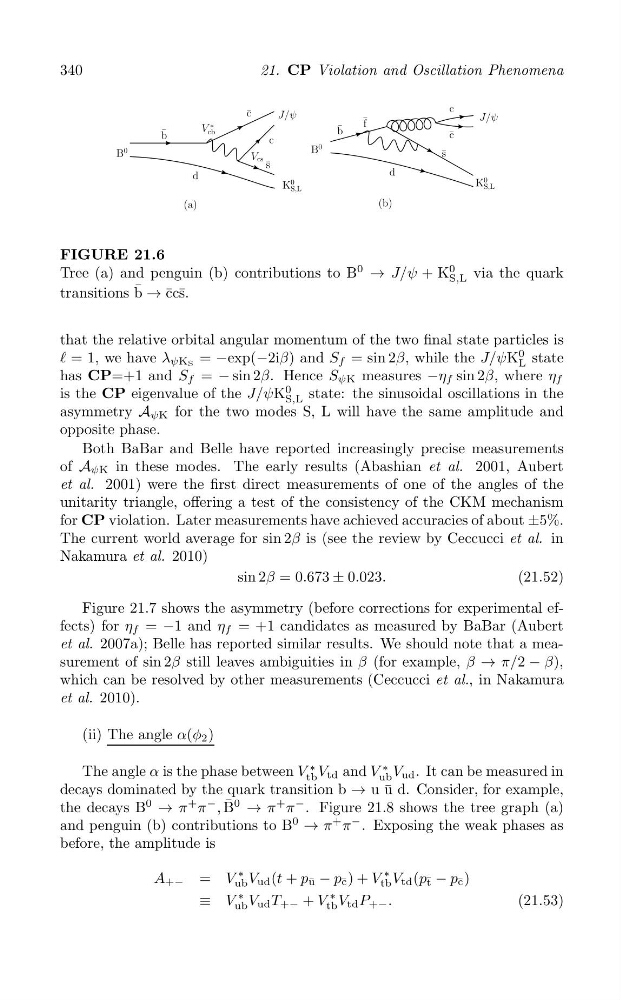
FIGURE 21.6
Tree (a) and penguin (b) contributions to B
0
→ J/ψ + K
0
via the quark
S,L
transitions b ¯ → ¯ cc¯ s.
that the relative orbital angular momentum of the two final state particles is
e = 1, we have λ ψKS = −exp(−2iβ) and S f = sin 2β, while the J/ψK
0 state
L
has CP=+1 and S f = − sin 2β. Hence S ψK measures −η f sin 2β, where η f
is the CP eigenvalue of the J/ψK
0
S,L state: the sinusoidal oscillations in the
asymmetry A ψK for the two modes S, L will have the same amplitude and
opposite phase.
Both BaBar and Belle have reported increasingly precise measurements
of A ψK in these modes. The early results (Abashian et al. 2001, Aubert
et al. 2001) were the first direct measurements of one of the angles of the
unitarity triangle, offering a test of the consistency of the CKM mechanism
for CP violation. Later measurements have achieved accuracies of about ±5%.
The current world average for sin 2β is (see the review by Ceccucci et al. in
Nakamura et al. 2010)
sin 2β = 0.673 ± 0.023.
(21.52)
Figure 21.7 shows the asymmetry (before corrections for experimental effects) for η f = −1 and η f = +1 candidates as measured by BaBar (Aubert
et al. 2007a); Belle has reported similar results. We should note that a measurement of sin 2β still leaves ambiguities in β (for example, β → π/2 − β),
which can be resolved by other measurements (Ceccucci et al., in Nakamura
et al. 2010).
(ii) The angle α(φ 2 )
∗
∗
The angle α is the phase between V tb V td and V ub V ud . It can be measured in
decays dominated by the quark transition b → u ¯
u d. Consider, for example,
the decays B
0
→ π
+ π
− , B ¯ 0 → π
+ π
− . Figure 21.8 shows the tree graph (a)
and penguin (b) contributions to B
0
→ π
+ π
− . Exposing the weak phases as
before, the amplitude is
∗
∗
A +− = V ub V ud (t + p u ¯ − p ¯ c ) + V tb V td (p¯ t − p ¯ c )
∗
∗
≡ V ub V ud T +− + V tb V td P +− .
(21.53)