

339
21.2. CP violation in B meson oscillations
and
2
¯
¯
Γ(B
0
→ f ) =
1 e
−Γt
{|A f | + |(q/p)A f |
2 + (|A f |
2
− |(q/p)A f |
2 ) cos Δm B t
t
2
q
− 2Im( A f
¯ A
∗
f ) sin Δm B t}.
(21.47)
p
¯
¯
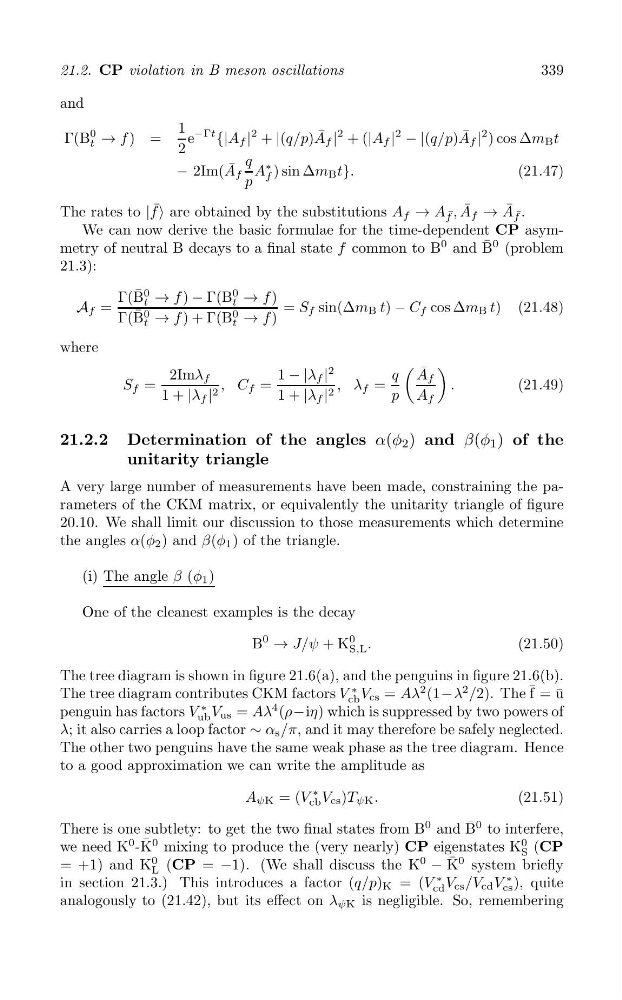
The rates to |f ¯ › are obtained by the substitutions A f → A f ¯, A f → A f ¯.
We can now derive the basic formulae for the time-dependent CP asymmetry of neutral B decays to a final state f common to B
0 and B ¯ 0 (problem
21.3):
Γ(B ¯ 0 → f ) − Γ(B
0
→ f )
t
t
A f =
= S f sin(Δm B t) − C f cos Δm B t) (21.48)
Γ(B ¯ 0 → f ) + Γ(B 0 → f )
t
t
where
(
)
2
¯
2Imλ f
1 − |λ f |
q A f
=
, C f =
, λ f =
.
(21.49)
S f
1 + |λ f | 2
1 + |λ f | 2
p A f
21.2.2 Determination of the angles α(φ 2 ) and β(φ 1 ) of the
unitarity triangle
A very large number of measurements have been made, constraining the parameters of the CKM matrix, or equivalently the unitarity triangle of figure
20.10. We shall limit our discussion to those measurements which determine
the angles α(φ 2 ) and β(φ 1 ) of the triangle.
(i) The angle β (φ 1 )
One of the cleanest examples is the decay
B
0
→ J/ψ + K
0
S,L .
(21.50)
The tree diagram is shown in figure 21.6(a), and the penguins in figure 21.6(b).
∗
¯
The tree diagram contributes CKM factors V cb V cs = Aλ
2 (1−λ
2 /2). The f = u ¯
∗
penguin has factors V V us = Aλ
4 (ρ−iη) which is suppressed by two powers of
ub
λ; it also carries a loop factor ∼ α s /π, and it may therefore be safely neglected.
The other two penguins have the same weak phase as the tree diagram. Hence
to a good approximation we can write the amplitude as
∗
A ψK = (V cb V cs )T ψK .
(21.51)
There is one subtlety: to get the two final states from B
0 and B ¯ 0 to interfere,
¯
we need K
0 -K
0 mixing to produce the (very nearly) CP eigenstates K
0 (CP
S
¯
= +1) and K
0 (CP = −1). (We shall discuss the K
0
− K
0 system briefly
L
∗
∗
in section 21.3.) This introduces a factor (q/p) K = (V V cs /V cd V ), quite
cd
cs
analogously to (21.42), but its effect on λ ψK is negligible. So, remembering