

331
21.1. Direct CP violation in B decays
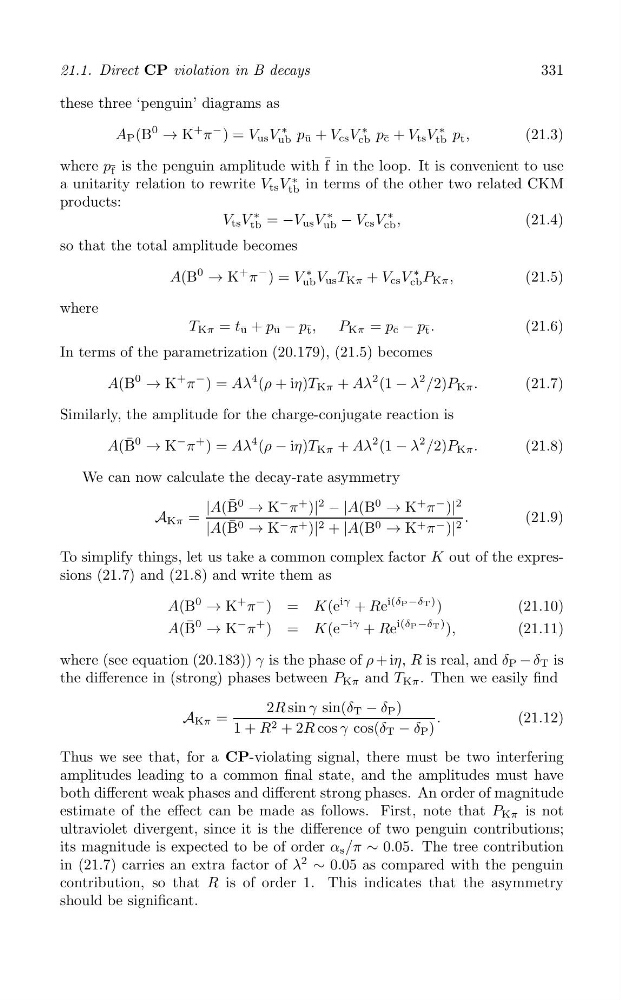
these three ‘penguin’ diagrams as
∗
∗
∗
A P (B
0
→ K
+ π
− ) = V us V ub p u ¯ + V cs V cb p ¯ c + V ts V tb p¯ t ,
(21.3)
¯
where p¯ is the penguin amplitude with f in the loop. It is convenient to use
f
∗
a unitarity relation to rewrite V ts V in terms of the other two related CKM
tb
products:
∗
∗
∗
=
V
V
(21.4)
V ts V tb −V us ub − V cs cb ,
so that the total amplitude becomes
∗
∗
A(B
0
→ K
+ π
− ) = V ub V us T Kπ + V cs V cb P Kπ ,
(21.5)
where
T Kπ = t u ¯ + p u ¯ − p¯ t , P Kπ = p ¯ c − p¯ t .
(21.6)
In terms of the parametrization (20.179), (21.5) becomes
A(B
0
→ K
+ π
− ) = Aλ
4 (ρ + iη)T Kπ + Aλ
2 (1 − λ
2 /2)P Kπ .
(21.7)
Similarly, the amplitude for the charge-conjugate reaction is
A(B ¯ 0 → K
− π
+ ) = Aλ
4 (ρ − iη)T Kπ + Aλ
2 (1 − λ
2 /2)P Kπ .
(21.8)
We can now calculate the decay-rate asymmetry
2
|A(B ¯ 0 → K
− π
+ )|
2
− |A(B
0
→ K
+ π
− )|
A Kπ =
.
(21.9)
2
|A(B ¯ 0 → K − π + )| 2 + |A(B 0 → K + π − )|
To simplify things, let us take a common complex factor K out of the expressions (21.7) and (21.8) and write them as
i(δP−δT) )
A(B
0
→ K
+ π
− ) = K(e
iγ + Re
(21.10)
i(δP−δT) ),
A(B ¯ 0 → K
− π
+ ) = K(e
−iγ + Re
(21.11)
where (see equation (20.183)) γ is the phase of ρ + iη, R is real, and δ P − δ T is
the difference in (strong) phases between P Kπ and T Kπ . Then we easily find
2R sin γ sin(δ T − δ P )
A Kπ =
.
(21.12)
1 + R 2 + 2R cos γ cos(δ T − δ P )
Thus we see that, for a CP-violating signal, there must be two interfering
amplitudes leading to a common final state, and the amplitudes must have
both different weak phases and different strong phases. An order of magnitude
estimate of the effect can be made as follows. First, note that P Kπ is not
ultraviolet divergent, since it is the difference of two penguin contributions;
its magnitude is expected to be of order α s /π ∼ 0.05. The tree contribution
in (21.7) carries an extra factor of λ
2
∼ 0.05 as compared with the penguin
contribution, so that R is of order 1. This indicates that the asymmetry
should be significant.