

332
21. CP Violation and Oscillation Phenomena
A(s − , s + )
A(s + , s − )
A B
˜
A B
V
∗
us
V cb
V
∗
cs
V ub
B
−
B
−
¯
u
s
K
−
π
−
K S
π
+
¯
u
s
K
−
π
+
K S
π
−
b
¯
u
¯
u
b
u
c
D
0
¯
D
0
s
s
¯ c
s −
s +
s +
s −
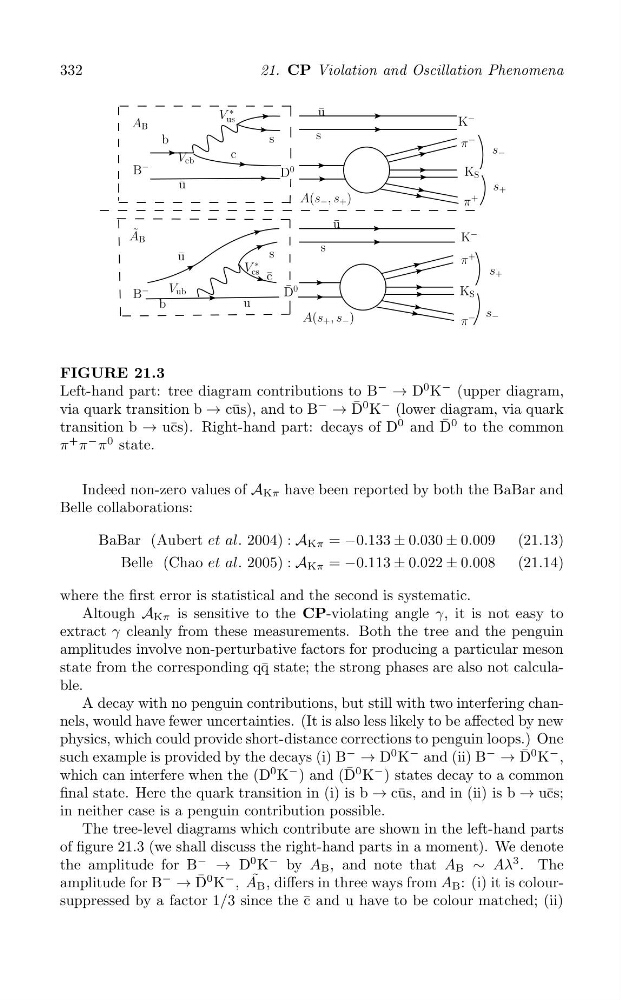
FIGURE 21.3
Left-hand part: tree diagram contributions to B
−
→ D
0 K
− (upper diagram,
via quark transition b → c¯ us), and to B
−
→ D ¯ 0 K
− (lower diagram, via quark
transition b → u¯ cs). Right-hand part: decays of D
0 and D ¯ 0 to the common
π
+ π
− π
0 state.
Indeed non-zero values of A Kπ have been reported by both the BaBar and
Belle collaborations:
BaBar (Aubert et al. 2004) : A Kπ = −0.133 ± 0.030 ± 0.009
(21.13)
Belle (Chao et al. 2005) : A Kπ = −0.113 ± 0.022 ± 0.008
(21.14)
where the first error is statistical and the second is systematic.
Altough A Kπ is sensitive to the CP-violating angle γ, it is not easy to
extract γ cleanly from these measurements. Both the tree and the penguin
amplitudes involve non-perturbative factors for producing a particular meson
state from the corresponding q¯ q state; the strong phases are also not calculable.
A decay with no penguin contributions, but still with two interfering channels, would have fewer uncertainties. (It is also less likely to be affected by new
physics, which could provide short-distance corrections to penguin loops.) One
such example is provided by the decays (i) B
−
→ D
0 K
− and (ii) B
−
→ D ¯ 0 K
− ,
which can interfere when the (D
0 K
− ) and (D ¯ 0 K
− ) states decay to a common
final state. Here the quark transition in (i) is b → c¯ us, and in (ii) is b → u¯ cs;
in neither case is a penguin contribution possible.
The tree-level diagrams which contribute are shown in the left-hand parts
of figure 21.3 (we shall discuss the right-hand parts in a moment). We denote
the amplitude for B
−
→ D
0 K
− by A B , and note that A B ∼ Aλ
3 . The
amplitude for B
−
→ D ¯ 0 K
− , A ˜ B , differs in three ways from A B : (i) it is coloursuppressed by a factor 1/3 since the ¯ c and u have to be colour matched; (ii)