

314
20. Introduction to the Phenomenology of Weak Interactions
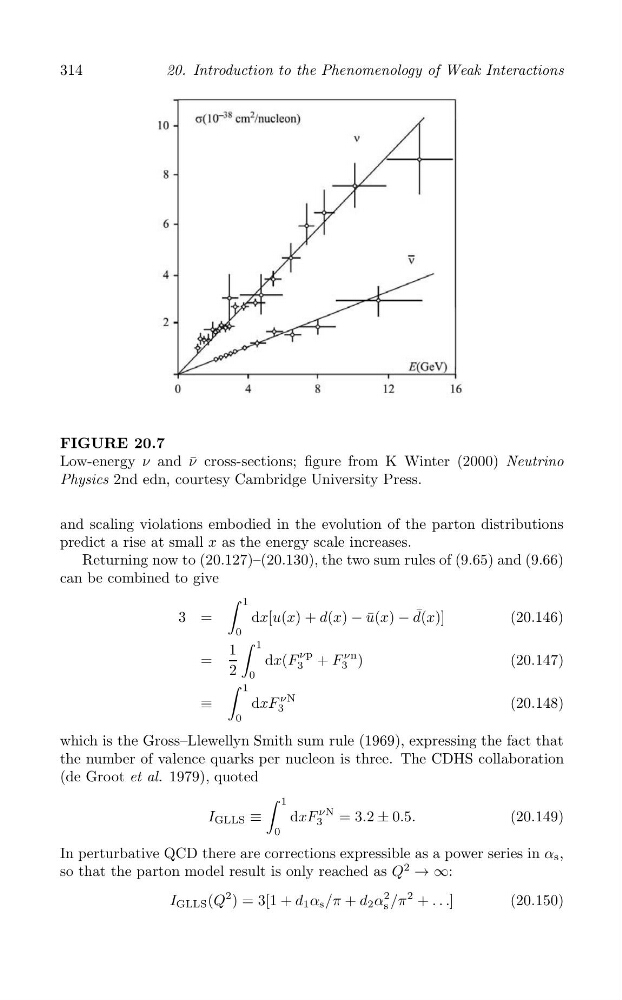
FIGURE 20.7
Low-energy ν and ¯
ν cross-sections; figure from K Winter (2000) Neutrino
Physics 2nd edn, courtesy Cambridge University Press.
and scaling violations embodied in the evolution of the parton distributions
predict a rise at small x as the energy scale increases.
Returning now to (20.127)–(20.130), the two sum rules of (9.65) and (9.66)
can be combined to give
∫ 1
3 =
dx[u(x) + d(x) − u ¯(x) − d ¯ (x)]
(20.146)
0
∫ 1
1
νp + F
νn
=
dx(F 3
3 )
(20.147)
2 0
∫ 1
≡
dxF
νN
(20.148)
3
0
which is the Gross–Llewellyn Smith sum rule (1969), expressing the fact that
the number of valence quarks per nucleon is three. The CDHS collaboration
(de Groot et al. 1979), quoted
∫ 1
I GLLS ≡
dxF
νN = 3.2 ± 0.5.
(20.149)
3
0
In perturbative QCD there are corrections expressible as a power series in α s ,
so that the parton model result is only reached as Q
2
→ ∞:
I GLLS (Q
2 ) = 3[1 + d 1 α s /π + d 2 α
2 /π
2 + . . .]
(20.150)
s