

310
20. Introduction to the Phenomenology of Weak Interactions
are finite. This scaling can again be interpreted in terms of pointlike scattering
from partons – which we shall take to have quark quantum numbers.
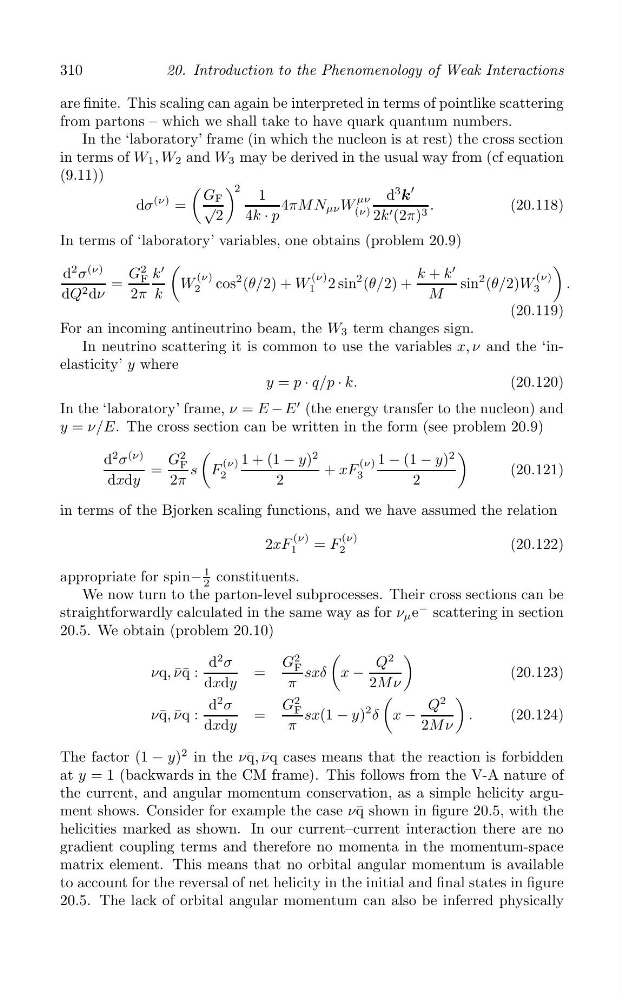
In the ‘laboratory’ frame (in which the nucleon is at rest) the cross section
in terms of W 1 , W 2 and W 3 may be derived in the usual way from (cf equation
(9.11))
(
) 2
G F
μν
1
d
3
k
′
dσ
(ν) = √
4πM N μν W
.
(20.118)
2 4k · p
(ν) 2k ′ (2π) 3
In terms of ‘laboratory’ variables, one obtains (problem 20.9)
(
)
d
2 σ
(ν)
G
2 k
′
k + k
′
F
(ν)
(ν)
(ν)
=
W cos
2 (θ/2) + W 2 sin
2 (θ/2) +
sin
2 (θ/2)W
.
2
1
3
dQ 2 dν
2π k
M
(20.119)
For an incoming antineutrino beam, the W 3 term changes sign.
In neutrino scattering it is common to use the variables x, ν and the ‘inelasticity’ y where
y = p · q/p · k.
(20.120)
In the ‘laboratory’ frame, ν = E − E
′ (the energy transfer to the nucleon) and
y = ν/E. The cross section can be written in the form (see problem 20.9)
(
)
d
2 σ
(ν)
G
2
F
(ν) 1 + (1 − y)
2
(ν) 1 − (1 − y)
2
=
s F
+ xF
(20.121)
2
3
dxdy
2π
2
2
in terms of the Bjorken scaling functions, and we have assumed the relation
(ν)
(ν)
2xF
= F
(20.122)
1
2
appropriate for spin−
1 constituents.
2
We now turn to the parton-level subprocesses. Their cross sections can be
straightforwardly calculated in the same way as for ν μ e
− scattering in section
20.5. We obtain (problem 20.10)
(
)
d
2 σ
G
2
Q
2
F
νq, ¯q :
=
sxδ x −
ν¯
(20.123)
dxdy
π
2M ν
(
)
d
2 σ
G
2
Q
2
F
νq ¯, ν ¯q :
=
sx(1 − y)
2 δ x −
.
(20.124)
dxdy
π
2M ν
The factor (1 − y)
2 in the νq ¯, ν ¯q cases means that the reaction is forbidden
at y = 1 (backwards in the CM frame). This follows from the V-A nature of
the current, and angular momentum conservation, as a simple helicity argument shows. Consider for example the case ν¯ q shown in figure 20.5, with the
helicities marked as shown. In our current–current interaction there are no
gradient coupling terms and therefore no momenta in the momentum-space
matrix element. This means that no orbital angular momentum is available
to account for the reversal of net helicity in the initial and final states in figure
20.5. The lack of orbital angular momentum can also be inferred physically