

309
20.7. Quark weak currents
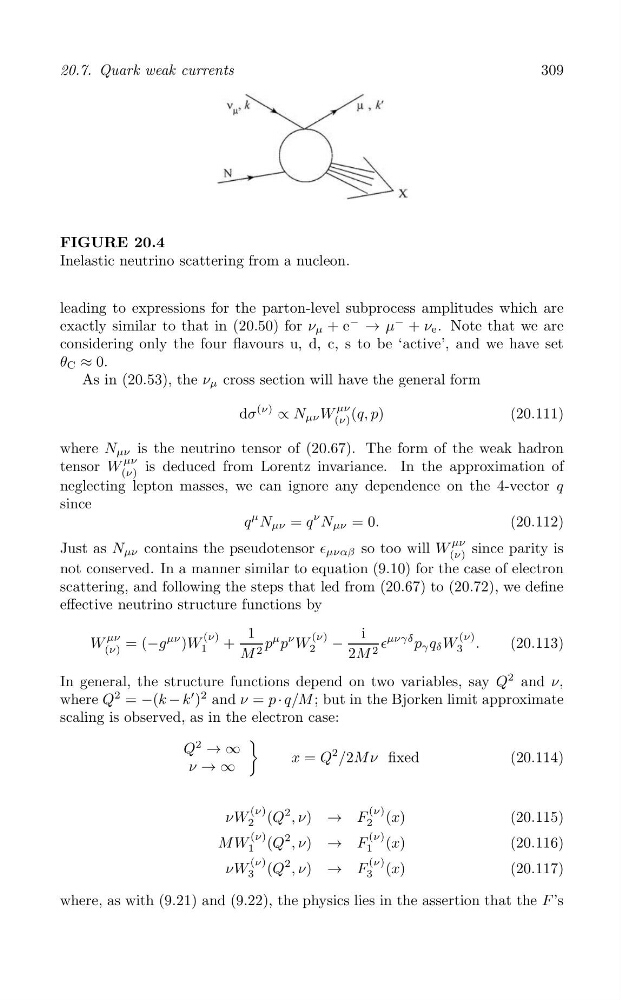
FIGURE 20.4
Inelastic neutrino scattering from a nucleon.
leading to expressions for the parton-level subprocess amplitudes which are
exactly similar to that in (20.50) for ν μ + e
−
→ μ
− + ν e . Note that we are
considering only the four flavours u, d, c, s to be ‘active’, and we have set
θ C ≈ 0.
As in (20.53), the ν μ cross section will have the general form
μν
dσ
(ν)
∝ N μν W (ν) (q, p)
(20.111)
where N μν is the neutrino tensor of (20.67). The form of the weak hadron
μν
tensor W
is deduced from Lorentz invariance. In the approximation of
(ν)
neglecting lepton masses, we can ignore any dependence on the 4-vector q
since
q
μ N μν = q
ν N μν = 0.
(20.112)
μν
Just as N μν contains the pseudotensor ∈ μναβ so too will W since parity is
(ν)
not conserved. In a manner similar to equation (9.10) for the case of electron
scattering, and following the steps that led from (20.67) to (20.72), we define
effective neutrino structure functions by
μν
μν )W
(ν)
1 μ
(ν)
i ∈
μνγδ
(ν)
W (ν) = (−g
1
+
p p
ν W 2 −
p γ q δ W 3 .
(20.113)
M 2
2M 2
In general, the structure functions depend on two variables, say Q
2 and ν,
where Q
2 = −(k − k
′ )
2 and ν = p · q/M ; but in the Bjorken limit approximate
scaling is observed, as in the electron case:
)
Q
2
→ ∞
x = Q
2 /2M ν fixed
(20.114)
ν → ∞
(ν)
(ν)
νW (Q
2 , ν) → F (x)
(20.115)
2
2
(ν)
(ν)
M W (Q
2 , ν) → F (x)
(20.116)
1
1
(ν)
(ν)
νW (Q
2 , ν) → F (x)
(20.117)
3
3
where, as with (9.21) and (9.22), the physics lies in the assertion that the F ’s