

308
20. Introduction to the Phenomenology of Weak Interactions
It is simple to verify that, whereas either part of (20.106) alone contains a
¯ ˆ
¯
strangeness changing neutral combination such as d{. . .}s ˆ or s ˆ{ } ˆ
. . . d, such
combinations vanish in the sum, leaving the result diagonal in quark flavour.
Thus there are no first-order neutral flavour-changing currents in this model,
a result which will be extended to three flavours in section 20.7.3.
In 1974, Gaillard and Lee (1974) performed a full one-loop calculation
of the K L − K S mass difference in the GSW model as extended by GIM
to quarks and using the renormalization techniques recently developed by ’t
Hooft (1971b). They were able to predict m c ∼1.5 GeV for the charm quark
mass, a result spectacularly confirmed by the subsequent discovery of the c¯ c
states in charmonium, and of charmed mesons and baryons of the appropriate
mass.
In summary, then, the essential feature of the quark weak currents in
the two-generation model is that they have the universal V-A form, but the
ˆ
ˆ
participating fields are (u, ˆ d ′ ), (ˆ c, s ˆ′ ) where d ′
ˆ
ˆ
and s ′ are not the fields d, s ˆ with
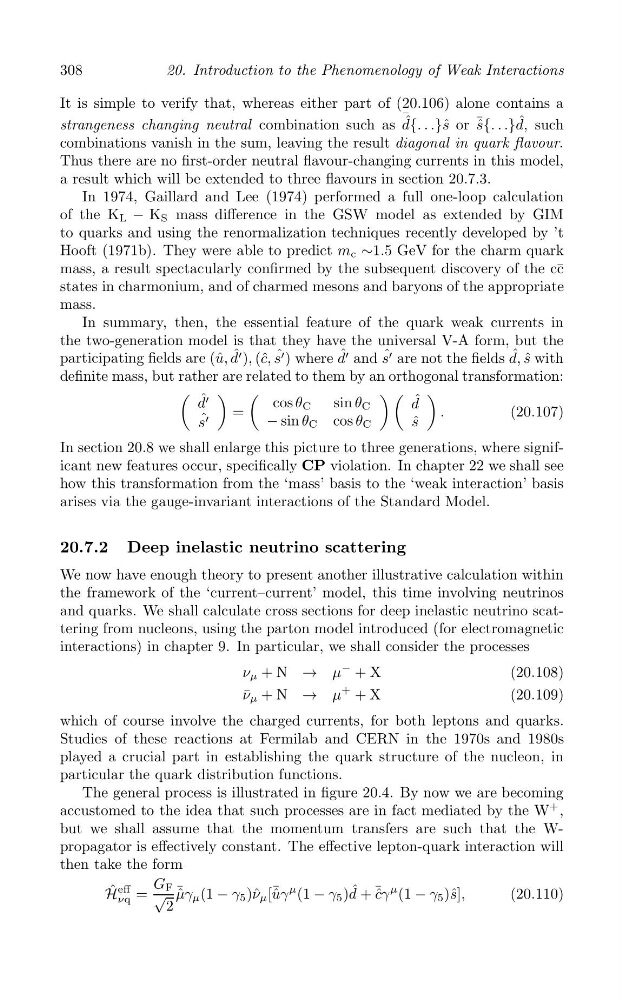
definite mass, but rather are related to them by an orthogonal transformation:
(
) (
) (
)
ˆ
d ′
cos θ
ˆ
=
C
sin θ C
d .
(20.107)
ˆ
s ′
− sin θ C cos θ C
s ˆ
In section 20.8 we shall enlarge this picture to three generations, where significant new features occur, specifically CP violation. In chapter 22 we shall see
how this transformation from the ‘mass’ basis to the ‘weak interaction’ basis
arises via the gauge-invariant interactions of the Standard Model.
20.7.2 Deep inelastic neutrino scattering
We now have enough theory to present another illustrative calculation within
the framework of the ‘current–current’ model, this time involving neutrinos
and quarks. We shall calculate cross sections for deep inelastic neutrino scattering from nucleons, using the parton model introduced (for electromagnetic
interactions) in chapter 9. In particular, we shall consider the processes
ν μ + N → μ
− + X
(20.108)
ν ¯ μ + N → μ
+ + X
(20.109)
which of course involve the charged currents, for both leptons and quarks.
Studies of these reactions at Fermilab and CERN in the 1970s and 1980s
played a crucial part in establishing the quark structure of the nucleon, in
particular the quark distribution functions.
The general process is illustrated in figure 20.4. By now we are becoming
accustomed to the idea that such processes are in fact mediated by the W
+ ,
but we shall assume that the momentum transfers are such that the Wpropagator is effectively constant. The effective lepton-quark interaction will
then take the form
H ˆ eff
G
√
F ¯
¯
νq =
μγ ˆ μ (1
2
− γ 5 )ˆ ν μ [uγ ˆ
μ (1 −
ˆ ¯
γ
μ
5 )d + cγ ˆ (1 − γ 5 )ˆ s],
(20.110)