

20.7. Quark weak currents
307
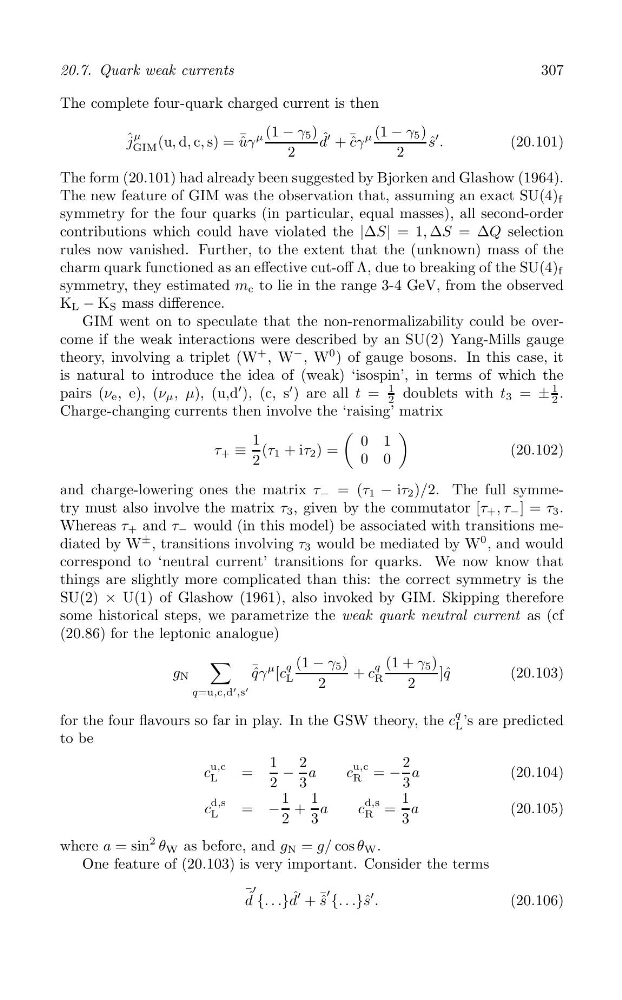
The complete four-quark charged current is then
ˆ μ
μ (1 − γ 5 )
γ
ˆ ′
μ (1
¯
¯
− 5 )
j GIM (u, d, c, s) = uγ ˆ
d + cγ ˆ
s ˆ
′ .
(20.101)
2
2
The form (20.101) had already been suggested by Bjorken and Glashow (1964).
The new feature of GIM was the observation that, assuming an exact SU(4) f
symmetry for the four quarks (in particular, equal masses), all second-order
contributions which could have violated the |ΔS| = 1, ΔS = ΔQ selection
rules now vanished. Further, to the extent that the (unknown) mass of the
charm quark functioned as an effective cut-off Λ, due to breaking of the SU(4) f
symmetry, they estimated m c to lie in the range 3-4 GeV, from the observed
K L − K S mass difference.
GIM went on to speculate that the non-renormalizability could be overcome if the weak interactions were described by an SU(2) Yang-Mills gauge
theory, involving a triplet (W
+ , W
− , W
0 ) of gauge bosons. In this case, it
is natural to introduce the idea of (weak) ‘isospin’, in terms of which the
pairs (ν e , e), (ν μ , μ), (u,d
′ ), (c, s
′ ) are all t =
1 doublets with t
1
3 = ± .
2
2
Charge-changing currents then involve the ‘raising’ matrix
(
)
1
0 1
τ + ≡ (τ 1 + iτ 2 ) =
(20.102)
2
0 0
and charge-lowering ones the matrix τ = (τ
−
1 − iτ 2 )/2. The full symmetry must also involve the matrix τ 3 , given by the commutator [τ + , τ ] = τ
−
3 .
Whereas τ + and τ would (in this model) be associated with transitions me−
diated by W
± , transitions involving τ 3 would be mediated by W
0 , and would
correspond to ‘neutral current’ transitions for quarks. We now know that
things are slightly more complicated than this: the correct symmetry is the
SU(2) × U(1) of Glashow (1961), also invoked by GIM. Skipping therefore
some historical steps, we parametrize the weak quark neutral current as (cf
(20.86) for the leptonic analogue)
∑
μ q (1 − γ 5 )
q (1 + γ 5 )
¯
g N
qγ ˆ [c L
+ c
2
R
]ˆ q
(20.103)
2
q=u,c,d ′ ,s ′
q
for the four flavours so far in play. In the GSW theory, the c L ’s are predicted
to be
u,c
1 2
c L
=
−
u,c
2
a
c R = − a
(20.104)
2 3
3
d,s
1 1
c L
= −
d,s
1
+ a
c R = a
(20.105)
2 3
3
where a = sin
2 θ W as before, and g N = g/ cos θ W .
One feature of (20.103) is very important. Consider the terms
¯ ˆ
′
ˆ
d {. . .}d
′
¯
+ s ˆ
′ {. . .}s ˆ
′ .
(20.106)