

61
2.6. Comments on the gauge principle in electromagnetism
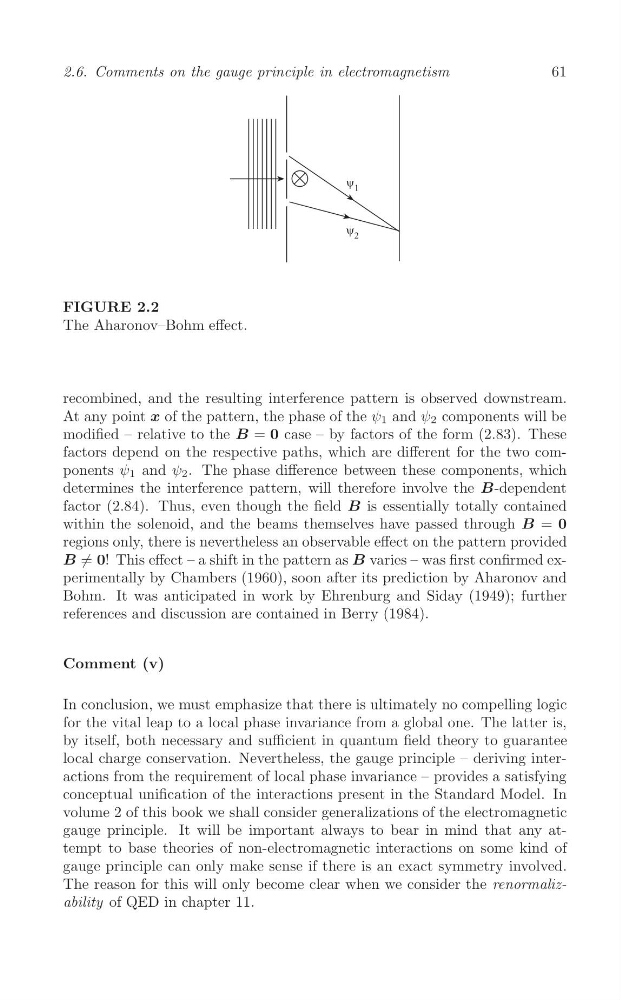
FIGURE 2.2
The Aharonov–Bohm effect.
recombined, and the resulting interference pattern is observed downstream.
At any point x of the pattern, the phase of the ψ 1 and ψ 2 components will be
modified – relative to the B = 0 case – by factors of the form (2.83). These
factors depend on the respective paths, which are different for the two components ψ 1 and ψ 2 . The phase difference between these components, which
determines the interference pattern, will therefore involve the B-dependent
factor (2.84). Thus, even though the field B is essentially totally contained
within the solenoid, and the beams themselves have passed through B = 0
regions only, there is nevertheless an observable effect on the pattern provided
B / 0! This effect – a shift in the pattern as B varies – was first confirmed
=
experimentally by Chambers (1960), soon after its prediction by Aharonov and
Bohm. It was anticipated in work by Ehrenburg and Siday (1949); further
references and discussion are contained in Berry (1984).
Comment (v)
In conclusion, we must emphasize that there is ultimately no compelling logic
for the vital leap to a local phase invariance from a global one. The latter is,
by itself, both necessary and sufficient in quantum field theory to guarantee
local charge conservation. Nevertheless, the gauge principle – deriving interactions from the requirement of local phase invariance – provides a satisfying
conceptual unification of the interactions present in the Standard Model. In
volume 2 of this book we shall consider generalizations of the electromagnetic
gauge principle. It will be important always to bear in mind that any attempt to base theories of non-electromagnetic interactions on some kind of
gauge principle can only make sense if there is an exact symmetry involved.
The reason for this will only become clear when we consider the renormalizability of QED in chapter 11.
2.6. Comments on the gauge principle in electromagnetism
FIGURE 2.2
The Aharonov–Bohm effect.
recombined, and the resulting interference pattern is observed downstream.
At any point x of the pattern, the phase of the ψ 1 and ψ 2 components will be
modified – relative to the B = 0 case – by factors of the form (2.83). These
factors depend on the respective paths, which are different for the two components ψ 1 and ψ 2 . The phase difference between these components, which
determines the interference pattern, will therefore involve the B-dependent
factor (2.84). Thus, even though the field B is essentially totally contained
within the solenoid, and the beams themselves have passed through B = 0
regions only, there is nevertheless an observable effect on the pattern provided
B / 0! This effect – a shift in the pattern as B varies – was first confirmed
=
experimentally by Chambers (1960), soon after its prediction by Aharonov and
Bohm. It was anticipated in work by Ehrenburg and Siday (1949); further
references and discussion are contained in Berry (1984).
Comment (v)
In conclusion, we must emphasize that there is ultimately no compelling logic
for the vital leap to a local phase invariance from a global one. The latter is,
by itself, both necessary and sufficient in quantum field theory to guarantee
local charge conservation. Nevertheless, the gauge principle – deriving interactions from the requirement of local phase invariance – provides a satisfying
conceptual unification of the interactions present in the Standard Model. In
volume 2 of this book we shall consider generalizations of the electromagnetic
gauge principle. It will be important always to bear in mind that any attempt to base theories of non-electromagnetic interactions on some kind of
gauge principle can only make sense if there is an exact symmetry involved.
The reason for this will only become clear when we consider the renormalizability of QED in chapter 11.