

285
20.1. Fermi’s ‘current–current’ theory of nuclear β-decay
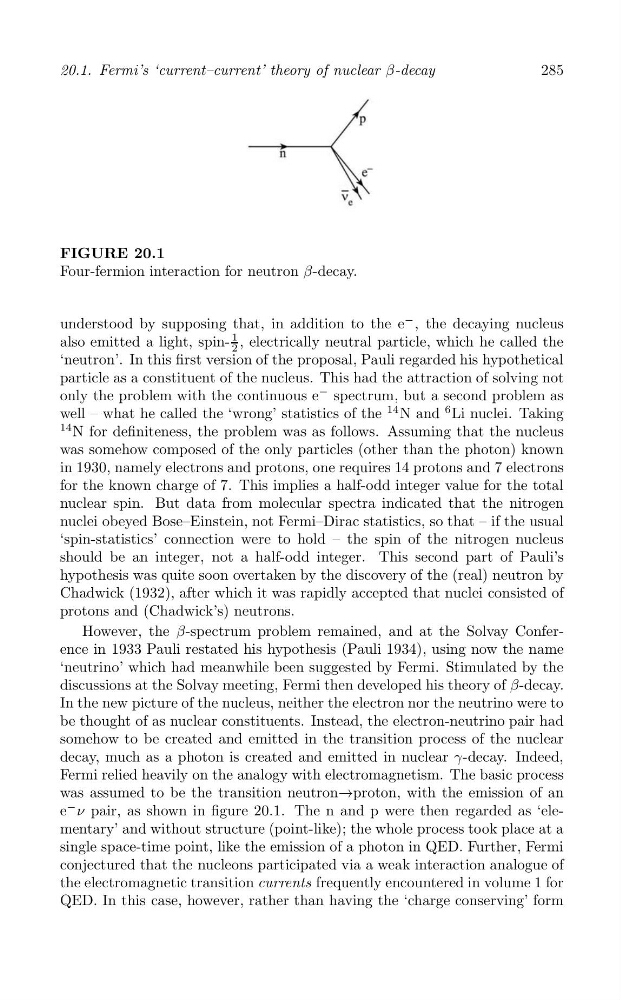
FIGURE 20.1
Four-fermion interaction for neutron β-decay.
understood by supposing that, in addition to the e
− , the decaying nucleus
also emitted a light, spin1 , electrically neutral particle, which he called the
2
‘neutron’. In this first version of the proposal, Pauli regarded his hypothetical
particle as a constituent of the nucleus. This had the attraction of solving not
only the problem with the continuous e
− spectrum, but a second problem as
well – what he called the ‘wrong’ statistics of the
14 N and
6 Li nuclei. Taking
14 N for definiteness, the problem was as follows. Assuming that the nucleus
was somehow composed of the only particles (other than the photon) known
in 1930, namely electrons and protons, one requires 14 protons and 7 electrons
for the known charge of 7. This implies a half-odd integer value for the total
nuclear spin. But data from molecular spectra indicated that the nitrogen
nuclei obeyed Bose–Einstein, not Fermi–Dirac statistics, so that – if the usual
‘spin-statistics’ connection were to hold – the spin of the nitrogen nucleus
should be an integer, not a half-odd integer. This second part of Pauli’s
hypothesis was quite soon overtaken by the discovery of the (real) neutron by
Chadwick (1932), after which it was rapidly accepted that nuclei consisted of
protons and (Chadwick’s) neutrons.
However, the β-spectrum problem remained, and at the Solvay Conference in 1933 Pauli restated his hypothesis (Pauli 1934), using now the name
‘neutrino’ which had meanwhile been suggested by Fermi. Stimulated by the
discussions at the Solvay meeting, Fermi then developed his theory of β-decay.
In the new picture of the nucleus, neither the electron nor the neutrino were to
be thought of as nuclear constituents. Instead, the electron-neutrino pair had
somehow to be created and emitted in the transition process of the nuclear
decay, much as a photon is created and emitted in nuclear γ-decay. Indeed,
Fermi relied heavily on the analogy with electromagnetism. The basic process
was assumed to be the transition neutron→proton, with the emission of an
e
− ν pair, as shown in figure 20.1. The n and p were then regarded as ‘elementary’ and without structure (point-like); the whole process took place at a
single space-time point, like the emission of a photon in QED. Further, Fermi
conjectured that the nucleons participated via a weak interaction analogue of
the electromagnetic transition currents frequently encountered in volume 1 for
QED. In this case, however, rather than having the ‘charge conserving’ form