

286
20. Introduction to the Phenomenology of Weak Interactions
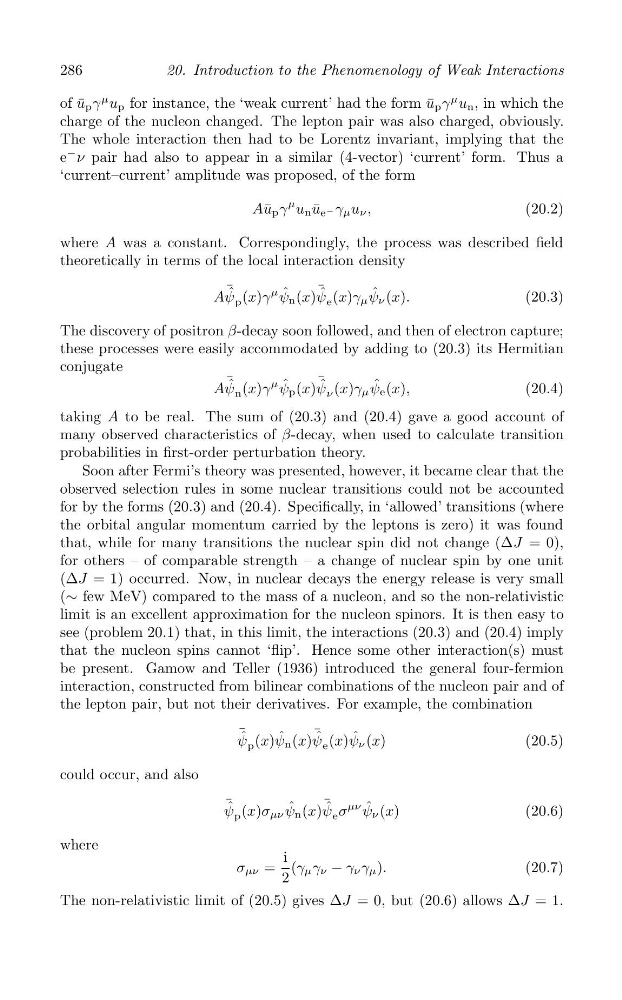
of ¯
u p γ
μ u p for instance, the ‘weak current’ had the form ¯
u p γ
μ u n , in which the
charge of the nucleon changed. The lepton pair was also charged, obviously.
The whole interaction then had to be Lorentz invariant, implying that the
e
− ν pair had also to appear in a similar (4-vector) ‘current’ form. Thus a
‘current–current’ amplitude was proposed, of the form
Au ¯ p γ
μ u n u ¯ e − γ μ u ν ,
(20.2)
where A was a constant. Correspondingly, the process was described field
theoretically in terms of the local interaction density
¯
¯
Aψ ˆ
p (x)γ
μ ψ ˆ n (x)ψ ˆ
e (x)γ μ ψ ˆ ν (x).
(20.3)
The discovery of positron β-decay soon followed, and then of electron capture;
these processes were easily accommodated by adding to (20.3) its Hermitian
conjugate
¯
¯
Aψ ˆ
n (x)γ
μ ψ ˆ p (x)ψ ˆ
ν (x)γ μ ψ ˆ e (x),
(20.4)
taking A to be real. The sum of (20.3) and (20.4) gave a good account of
many observed characteristics of β-decay, when used to calculate transition
probabilities in first-order perturbation theory.
Soon after Fermi’s theory was presented, however, it became clear that the
observed selection rules in some nuclear transitions could not be accounted
for by the forms (20.3) and (20.4). Specifically, in ‘allowed’ transitions (where
the orbital angular momentum carried by the leptons is zero) it was found
that, while for many transitions the nuclear spin did not change (ΔJ = 0),
for others – of comparable strength – a change of nuclear spin by one unit
(ΔJ = 1) occurred. Now, in nuclear decays the energy release is very small
(∼ few MeV) compared to the mass of a nucleon, and so the non-relativistic
limit is an excellent approximation for the nucleon spinors. It is then easy to
see (problem 20.1) that, in this limit, the interactions (20.3) and (20.4) imply
that the nucleon spins cannot ‘flip’. Hence some other interaction(s) must
be present. Gamow and Teller (1936) introduced the general four-fermion
interaction, constructed from bilinear combinations of the nucleon pair and of
the lepton pair, but not their derivatives. For example, the combination
¯
¯
ψ ˆ
p (x)ψ ˆ n (x)ψ ˆ
e (x)ψ ˆ ν (x)
(20.5)
could occur, and also
¯
¯
ˆ
ˆ
ˆ σ
μν ˆ
ψ p (x)σ μν ψ n (x)ψ e
ψ ν (x)
(20.6)
where
i
σ μν = (γ μ γ ν − γ ν γ μ ).
(20.7)
2
The non-relativistic limit of (20.5) gives ΔJ = 0, but (20.6) allows ΔJ = 1.