

284
20. Introduction to the Phenomenology of Weak Interactions
night of 6/7 December. – With my best regards to you, and also Mr.
Back, your humble servant,
W. Pauli
Quoted from Winter (2000), pages 4–5.
At the end of the previous chapter we arrived at an important part of the
Lagrangian of the Standard Model, namely the terms involving just the gauge
and Higgs fields. The full electroweak Lagrangian also includes, of course, the
couplings of these fields to the quarks and leptons. We could at this point simply write these couplings down, with little motivation, and proceed at once to
discuss the empirical consequences. But such an approach, though economical, would assume considerable knowledge of weak interaction phenomenology
on the reader’s part. We prefer to keep this book as self-contained as possible,
and so in the present chapter we shall provide an introduction to this phenomenology, following a ‘semi-historical’ route (for fuller historical treatments
we refer the reader to Marshak et al. 1969, or to Winter 2000, for example).
Much of what we shall discuss is still, for many purposes, a very useful
approximation to the full theory at energies well below the masses of the W
±
(∼80 GeV) and Z
0 (∼90 GeV). The reason for this is that in the electroweak
theory (chapter 22), tree-level amplitudes have a structure very similar to that
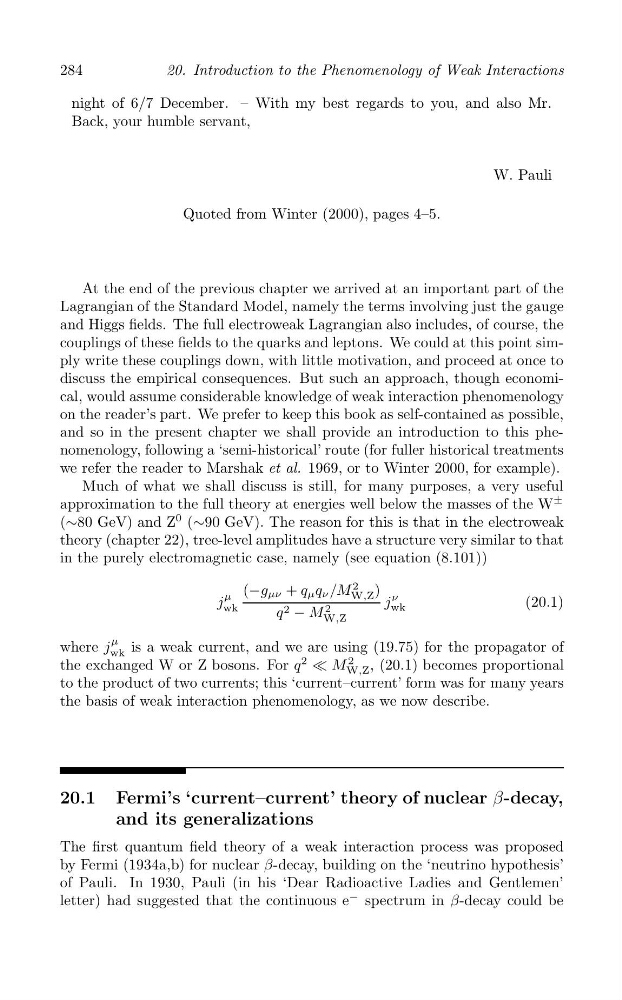
in the purely electromagnetic case, namely (see equation (8.101))
(−g μν + q μ q ν /M
2
)
μ
W,Z
j
j
ν
(20.1)
wk
wk
q 2 − M 2
W,Z
μ
where j is a weak current, and we are using (19.75) for the propagator of
wk
the exchanged W or Z bosons. For q
2
≪ M
2
, (20.1) becomes proportional
W,Z
to the product of two currents; this ‘current–current’ form was for many years
the basis of weak interaction phenomenology, as we now describe.
20.1 Fermi’s ‘current–current’ theory of nuclear β-decay,
and its generalizations
The first quantum field theory of a weak interaction process was proposed
by Fermi (1934a,b) for nuclear β-decay, building on the ‘neutrino hypothesis’
of Pauli. In 1930, Pauli (in his ‘Dear Radioactive Ladies and Gentlemen’
letter) had suggested that the continuous e
− spectrum in β-decay could be